As students and teachers alike adapt to the newly implemented personal device policy, perspectives surrounding its benefits continue to vary, with some arguing its improvement to classroom activity and others noting the deeper implications of state interference.
By Katelee Ngo
To some teachers, the policy is a comfort. “It’s nice because I hate being the bad guy,” said Mr. Baker, a teacher from the science department. “I hate being the cell phone police. With AP Bio, I’ve played the cop out role of, ‘It’s an elective; you chose to be here, and if you wanna play on your phone the whole time and not know this stuff, that’s up to you.’ But [now], I feel like I don’t have to do that.”
With a similar attitude, history teacher Mr. Peffer explained his leniency towards phone use in his classroom prior to the formal policy’s enactment. “It wasn’t a battle that I was going to fight because there wasn’t a background to it. It was more on a teacher to enforce the rule. When it became a state law and it became a policy that was going to be backed up, that’s when it started to be enforced.”
About a month into the new school year, both teachers noted changes in student behavior. “My group of seniors that I have now seem to be more attentive,” said Mr. Peffer. “But I don’t know if it’s the phone or not.”
Mr. Baker said, “It does seem like they’re a little more focused. I think seeing their peers not have it out helps.”
However, senior Sahana Reka (12) had concerns regarding the policy’s long-term impacts on the development of today’s youth. “Putting too many legal restrictions on stuff is, first of all, infringing on people’s freedom. That’s dangerous because you’re making more ways that adolescents have to rely on adults for directions on what to do with their lives, and you’re not letting them transform into independent human beings who can make their own decisions.”
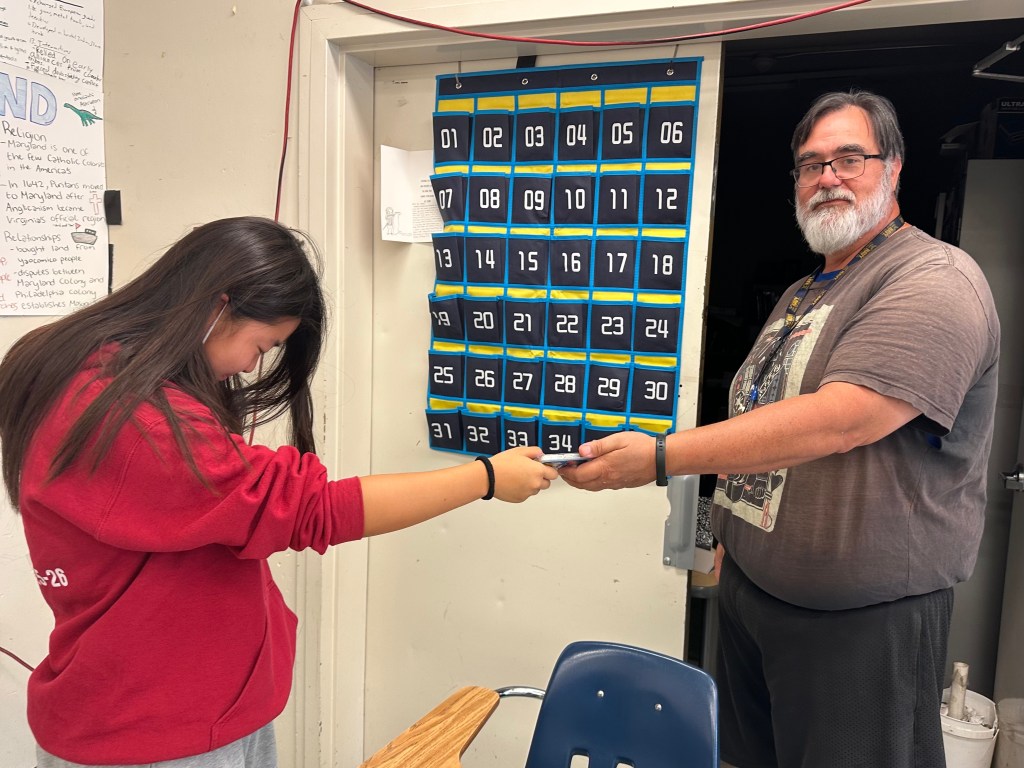
In her second period AP Economy class, Hannah Lee (12) handed her phone to Mr. Peffer. He continues to remind students to put their personal devices aside. “[Even] without the phone, kids may not be paying attention, but the likelihood of them not doing something has lessened,” said Mr. Peffer (Photo credit: Katelee Ngo (12)).
While she did believe that phone use in the classroom should be regulated, Reka did not agree with how such restrictions are being imposed. “You don’t need a whole law for the benefits,” she said. “You can just make rules within the classroom. The law is overstepping.”
Mr. Baker also commented on the implications of legal interference. “I would say in a perfect world, people in the state legislature shouldn’t be telling us how to do that. In this case, it worked out. In most cases, it doesn’t often work out.”
Freshman Ritisha Datta (9), on the other hand, was simply happy for the opportunity to use her phone at all. “At first, I was a little bit like, ‘Ugh, that’s so lame.’ But pretty quickly, I realized I should be grateful,” she said. “Coming straight from Thornton, being able to use your phones at all in school is just so much of a blessing.”
!! “Thornton’s phone policy was no phones from the first bell all the way to the end of school, no exceptions to that,” Datta continued. “That was a little bit unnecessary given how big of a part phones are in today’s social culture. Using it at lunch and brunch seems pretty reasonable.”
Similarly, Mr. Baker drew comparisons between the policy at AHS and the policy at other schools. “I kind of like that we didn’t go super hardcore,” he said. “Some schools have it [where] you have to put your phone when you walk into school that day into one of these bags. I was telling my students ‘Please don’t make me use this [the phone pouches].’ I don’t want to feel like it’s kindergarten.”
Still, Reka emphasized her concerns with the micromanagement of students’ behavior. “If we give [students] more freedom, they have to learn to take responsibility for their actions. And a lot of people are pretty responsible about it, a lot of people aren’t responsible about it, but then they suffer the consequences. If we keep holding their hand throughout the high school process and say, ‘Oh you can’t use your phone because you’re gonna get distracted,’ then when are they gonna learn on their own what they should and should not do for their own good?”


Leave a Reply