An analysis of female student-athletes playing male-dominated sports
By Kaitlyn Liu
The sound of cleats sliding across sleek grass fields is accompanied by shrill whistles as the cheers of game-winning goals echo through the cold air. With the winter sports season starting and practices back in session, athletes are preparing for upcoming games. This includes girls’ soccer and wrestling, sports that many associate with being male-dominated.
People’s perceptions do not reflect a significant gap between athletes’ skill levels but are instead the result of sexism. Kathleen Masnik (11), who plays a variety of sports, joined wrestling alongside one of her friends and has become particularly successful at it. She stated, “People think I play volleyball or sports like that because wrestling just isn’t really a common sport for girls to do.”
Valerie Dee (11), who joined wrestling for the first time this year, supported Masnik’s statements. She said, “People think wrestling is a dangerous sport, and they feel scared for me.”
As girls’ wrestling and boys’ wrestling happen simultaneously—they share the same season and mat room—Dee said, “Most practice has been co-ed, but lately, they’ve been having girls-only practices where they train us on specific techniques that girls are better at.”
During her time on the wrestling team, Masnik added that girls getting a chance to wrestle with boys is a great opportunity to improve and fine-tune their skills. She said, “The biggest difference is between JV and Varsity; it’s not necessarily between boys and girls.”
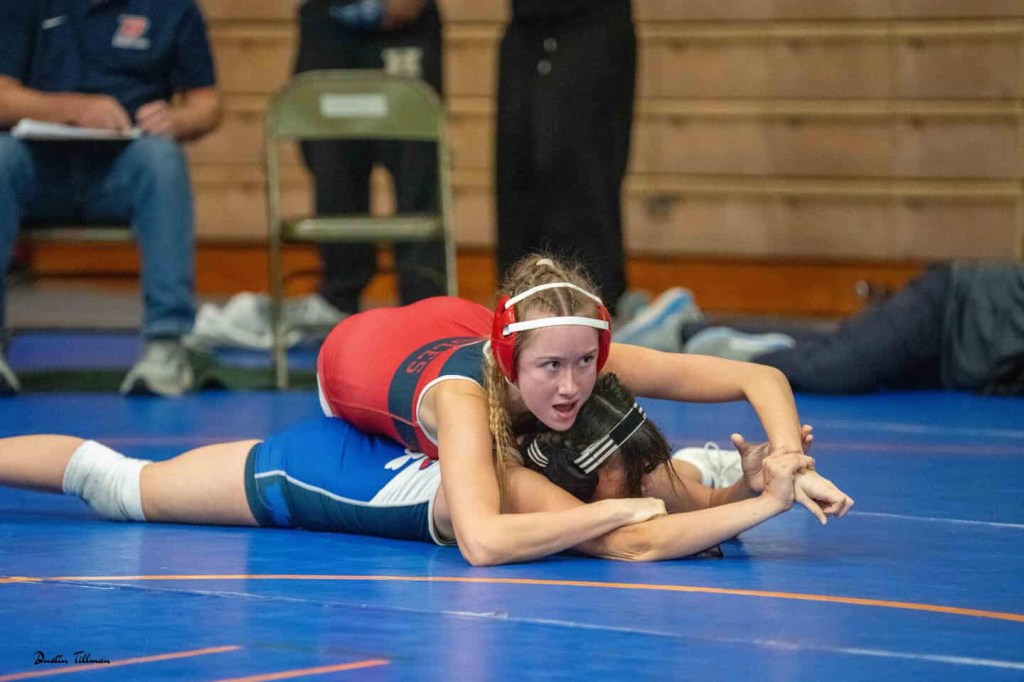
Kathleen Masnik (11) displayed her wrestling techniques on the mat during a tournament (Photo Credit: Coach Tillman).
Coach Tillman, a wrestling coach at AHS, built on Masnik’s statement, saying, “Wrestling is about discipline and skill, not gender.”
While there initially was a lack of support for girls in wrestling both in local and global contexts, Coach Tillman stated, “Progress has been made with more teams, more matches, and greater visibility. But we still need equal resources, consistent scheduling, and continued advocacy.”
Gabriella Castellino (11) started playing soccer when she was 6 years old, under the influence of her parents, and she acknowledged the role of physicality in the differences between boys’ and girls’ soccer. She said, “Men’s soccer is faster because the male physique is typically faster than that of women.”
But on a global scale, Castellino discussed a difference that she found while watching soccer on TV. She said, “Women’s soccer doesn’t have as much media attention outside of the US, but in the U.S., it’s been getting a lot more popular.”
Castellino described some of the female role models in sports she looked up to. “One of my biggest inspirations is the U.S. women’s soccer team when they were playing the World Cup 2023. Just seeing how they fought for equal pay and the way they kept winning their games was so inspirational,” Castellino said.
Thankfully, female student athletes in AHS sports teams have not been frequently affected by differences in coaching or treatment, unlike that of many professional female athletes. Sports have no gender: as times and norms continue to change, female athletes deserve just as much attention and respect as their male counterparts.





Leave a comment