How the blurred lines of club policy have impacted students
By Shiv Gurjar, Anthony Liu, and Jonathan Wang
Spotlight/Web Editor, Staff Writers
Clubs are one of the most visible parts of campus life. Ranging from academic to competitive to cultural, clubs at AHS offer students a chance to learn, connect, and develop new skills alongside peers who share similar passions.
However, behind the scenes of creating and maintaining clubs lies a controversial system managed by administrators and the ASB Club Committee. Many club leaders find these official processes inefficient and frustrating, while administrators and the ASB Club Committee uphold the system as necessary and effective. This difference in experiences exposes a grey area between how the system is intended to work and how students experience it in practice.
An Eagle Era investigation found that many clubs face significant barriers that limit growth and student participation, leaving them unable to fully engage members or pursue meaningful projects.
Club Approval
For many students, founding a new club begins with a simple idea. Yet, turning that into an officially recognized organization can take months of planning and paperwork.
To create a club, students first have to create a proposal which requires research of the requirements, defining the club’s mission, and completing the formal application process. From there, students must gather at least 25 signatures, recruit potential officers, and secure a faculty advisor as part of their proposal.
“At times, it felt like you were jumping through hoops for paperwork rather than focusing on the club itself,” said Vaishnavi Kalyanashetty (11), who attempted to start an aerospace-focused club. “It took about 3 to 4 months from the initial idea to the point where the application was submitted.”
“The main thing is when picking clubs to be at AHS, we want to make sure that these clubs are actually adding to the community and not just adding a slot on your college application, which is why all of that [paperwork] is important,” said Sage Gebrekidan (12), head of the Club Committee and co-captain of the Mock Trial Club. “If, let’s say, we decide that you don’t have to prove that you have a meeting every month, you could start a club and say you do all these things and then not actually do them. That could open the space for a lot of fraud.”
Of the 140 club charters submitted this year, only 80 were approved. Previously accepted clubs—not just new ones—are also required to recharter annually.
During the summer, the ASB Club Committee announces incoming clubs via a decision email, which listed the three most common general reasons for rejection: “Liability with the school,” “The club’s focus was too specific,” and “Another club already exists with a similar capacity.”
Kalyanasheety, who spent months preparing and was rejected, was disappointed by the general response. “It was difficult to know what specific changes could have improved the application,” she said.
Mr. Anderson, the ASB chair, said that the vagueness is intentional. “When we start giving reasons for why we have declined the club, they start just going around those reasons.”
When Rishab Sehgal’s (12) application for a civics club was eventually rejected, he reached out to a member of Club Committee, who explained that the club was too political. “I thought that was a really dumb response because if anything, a civics club would make people more politically engaged and foster connection and unity across the political landscape,” he said.
The rejection, however, reflects the school’s broader concern of neutrality. Mr. Anderson said that because all clubs operate under the school’s ASB system, every club essentially speaks on behalf of the school. “It’s like I can’t go posting something on our social media account about Democrats or Republicans,” he said. “Because the clubs all represent the school, we can’t have the school leaning a certain way.”
Managing a Club
Even after the challenging process of getting a club approved, running one can be just as demanding. Club leaders must adhere to a strict set of rules and regulations, many of which they said feel more punitive than supportive.
One of the Club Committee’s responsibilities is to facilitate clear communication between clubs and the committee through monthly binders. Clubs submit monthly binders to report activities and meetings, which help keep everyone informed and allow the committee to monitor compliance with school rules. Clubs can receive strikes for failing to submit a binder on time or for breaking other regulations. Accumulating 3 strikes results in a club being disbanded.
However, many club leaders have found these rules to be harsh. Lin said, “Our last strike was because the wrong date was put on the binder accidentally, but everything else was correct.”
“I think the system should give clubs a chance to correct mistakes before they receive strikes,” Arya Kunisetty (Class of 2025), former leader of Quiz Bowl Club, said, “It sometimes feels overly bureaucratic—like the process is designed more to catch errors than support student initiatives.”
Gebrekidan said, “We don’t find joy in getting mad at clubs. Of course, we always try to make clubs’ lives easier; one way I did that was by combining the November and December binders this year, because there were finals, and I wanted to give them a little peace of mind.”
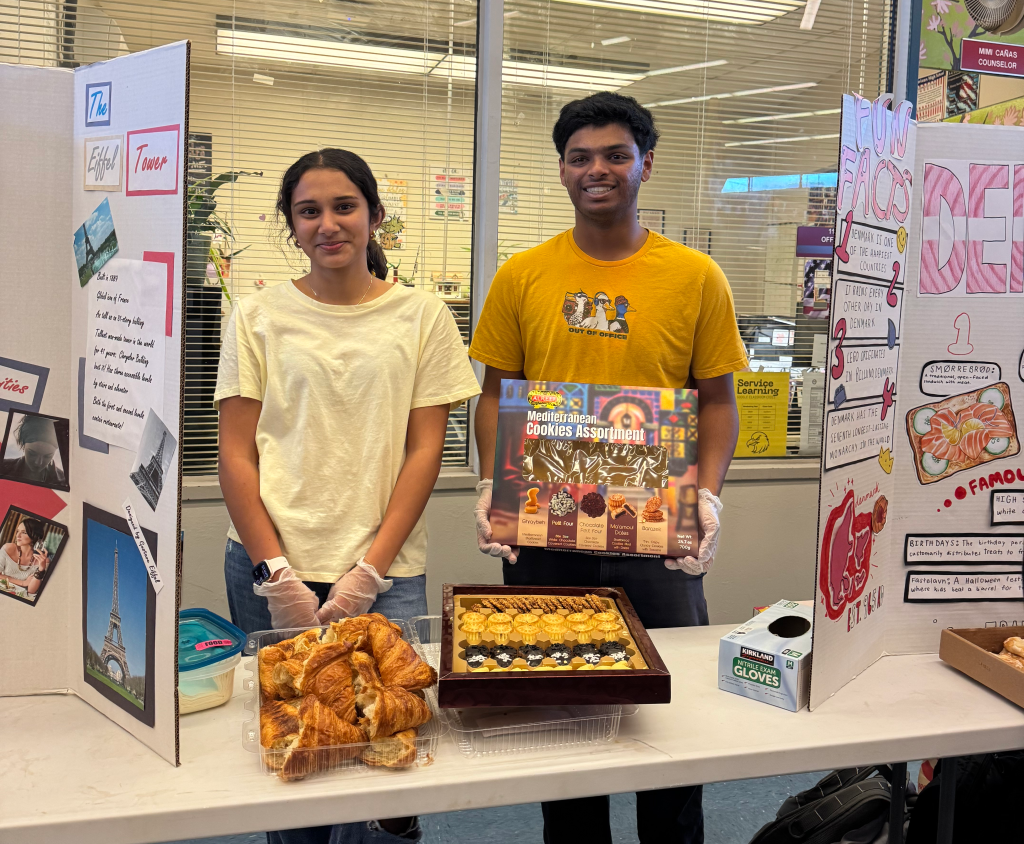
Sricharan Sadagopan (12), the president of the Game Club, and Siya Deshmukh (11) presented on Mediterranean culture during International Week, one of several school-wide rules clubs must fulfill alongside their regular activities (Photo Credit: Rishab Sehgal (12)).
“If there’s any club that has a deep hatred or really wants to change something, they could contact us. And if they make a good argument, of course, we can always change things,” she said.
Financial Insecurity
One rule in particular that has sparked significant controversy is that student funds are held in bank accounts managed by the school. Since ASB is a nonprofit organization, all financial activity must go through the school. This means that every deposit and withdrawal of money needs to be signed through a form before the action. Many clubs have found that the process takes much longer than expected.
Timothy Lin (12), an officer of the Youth Alive club, said, “The whole process, including the dispensing of money, reimbursements, and updating our account balance, can take far longer than those 2 weeks.”
School accounts clerk Mrs. Phillips, who oversees the entire process and manages club finances and bookkeeping, emphasized that these delays are avoidable. She said, “Delays are only caused if clubs miss deadlines or submit incorrect paperwork.”
The way funds are overseen can also restrict how clubs can fundraise under school rules. One rule that has drawn significant criticism is the requirement that clubs can only collect cash for fundraisers, rather than allowing card or digital payments.
For instance, Aneek Mandal (12), former leader of the now-dissolved Photography Club, described how this rule limited their club’s fundraising during a boba-selling event. “Many people wanted to buy boba, but since they didn’t hold cash, they were left without a drink, and we really didn’t fundraise that much.”
Ms. Phillips has confirmed that clubs are not restricted to cash, and the Club Committee has tried to contest the rule. However, the challenge with credit card use is largely logistical rather than something strict, according to Mr. Anderson.
While ASB owns equipment to read credit cards, the school is unable to create new accounts to use the service for each club. “We would have to give managing access to the accounts to whoever wanted to use the credit card machine. There really is no logistical way for clubs to have access,” said Mr. Anderson.
“They can maybe have people make online payments and show receipts, but that’s about it,” said Mr. Anderson. “If anybody messes anything up, the whole school loses its ASB non-profit status.”
The challenges, ranging from financial delays to fundraising limitations and complex approval processes, can make it difficult for clubs to operate smoothly and expand their impact. As a result, what is intended to be a structured system often feels like a barrier to participation for students.

 Eagle Era
Leave a comment