Incident involving attendee with Tourette’s syndrome raises questions about editing decisions and disability awareness
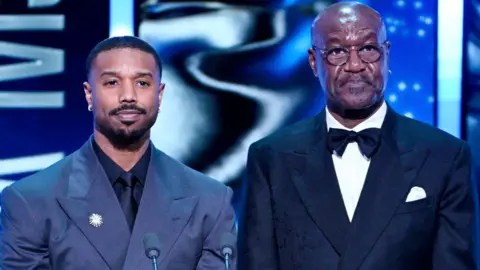
At this year’s British Academy Film and Television Arts (BAFTAs) award show ceremony, a controversial incident raised questions about the organization’s censorship practices and approach to disability representation. During an award presentation involving Michael B. Jordan and Delroy Lindo, two Black actors, campaigner John Davidson’s Tourette syndrome caused a vocal tic of a racial slur.
The incident aired uncensored, despite the fact that the BAFTAs operate on a 2-hour broadcast delay, which typically allows producers to review and edit content before it is put on air. The controversy intensified when audiences discovered that during the same broadcast, the BAFTAs had censored a separate instance of a filmmaker saying “Free Palestine” in his acceptance speech. This selective editing has sparked debate about the BAFTA’s editorial standards, decision-making process, and overall responsibility as an organization.
Davidson attended the BAFTAs specifically to promote his film about destigmatizing Tourette syndrome, making the incident particularly damaging. Kritika Sarkar (11) said, “Now, so many people on social media are hating on this guy, saying he was faking his Tourette syndrome, or blaming him for saying the N-word when it was his Tourette syndrome—it wasn’t some voluntary thing. There ends up being the opposite effect,” she said.
James Lee (11) emphasized the intentionality behind these decisions. “Not censoring his tic and then censoring ‘Free Palestine’ is like specifically choosing to stigmatize [Tourette syndrome]. It’s like they’re specifically doing it to show, ‘Oh, look at how crazy these people are.’ It feels very targeted,” he said.
Sarkar expressed skepticism about whether the incident was truly accidental. “I didn’t know what the BAFTAs were beforehand. Through this situation, I think they wanted more publicity, so more people would watch. Why else would they seat him 40 rows back and then put a microphone right in front of him, knowing he had tics? They set him up,” she said.
The incident has prompted conversation regarding the organization’s jurisdiction over censorship of “hate speech” or political statements. “I think they should have censored the N-word, because that is clearly hate speech. But ‘Free Palestine’ isn’t, because all you’re saying is that we should help the people of Palestine,” Sarkar said. “You’re not supporting the country itself; you’re supporting the people, who are just regular civilians who didn’t do anything wrong.”
The BAFTAs have also spurred discussions about the involvement of politics in art settings like award shows. Some attribute the BAFTA’s choice to censor “Free Palestine” as a way to try to maintain some kind of political neutrality. Teacher DeBlonk, an English teacher, said, “Everything has a political aspect to it, no matter what. And this choice the BAFTAs made is making a very clear political statement. Choosing to censor someone saying ‘Free Palestine’ is more of a political statement for the award ceremony itself than to allow someone on stage to say what they said.”
Beyond the political statement, Teacher DeBlonk also emphasized the broader responsibility of the awards show toward the individuals involved. “This has put so much attention on [Davidson] in a way that was entirely preventable,” they said. “The award ceremony has a responsibility to the actors, because it’s very distressing to have this word yelled at you, but it’s also distressing to the person who they invited to the award ceremony who has a tic.”
As the BAFTAs face continued scrutiny over their handling of both the Tourette syndrome incident and the “Free Palestine” censorship, the situation serves as a reminder of the consequences when organizations fail to balance their responsibilities with the needs of the individuals they invite. Both Davidson and the BAFTAs have since issued apologies for the situation. “I do think it was proper for [Davidson] to put out a response because of what happened,” Teacher DeBlonk said. “That should be the end of it, though. It happened, he explained, and he apologized.”


 Eagle Era
Leave a comment