The California Green Ribbon Schools Program awarded AHS for environmentally friendly practices
On February 12th, State Superintendent Tony Thurmond announced the recipients of the 2026 California Green Ribbon Schools (CA-GRS) Awards. Among the honorees were AHS and FUSD, which both received Gold recognitions for achieving 75 percent or greater environmental efficiency.
According to the California Department of Education, “The CA-GRS Award program evaluates applications from public schools, districts, and county offices of education to recognize outstanding achievements in environmental excellence.”
This recognition highlights the impact of community collaboration on district-wide sustainability efforts. “Being recognized as a California Green Ribbon School District Sustainability Honoree is a testament to the collective efforts of our schools, staff, students, and community,” said FUSD Superintendent Zack Larsen in a district press release.
According to Nate Ivy, an FUSD Teacher on Special Assignment for Community Initiatives and Partnerships, student involvement has played a key role in encouraging the district to adopt stronger sustainability policies. FUSD has also developed partnerships with local government and organizations such as the Alameda County Water District to support climate action initiatives, including improving the energy and water efficiency of school facilities and providing teachers with professional development in environmental education.
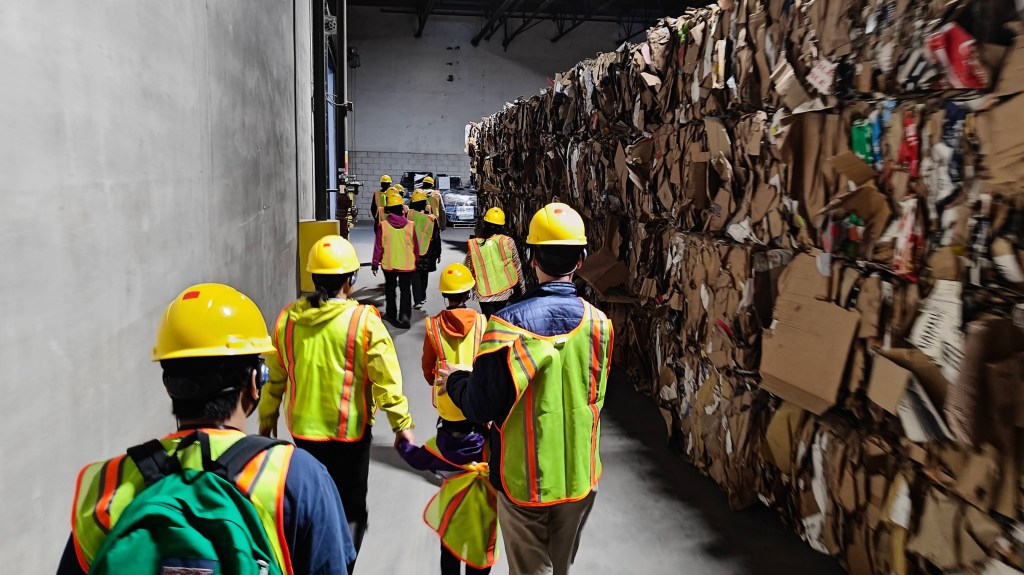
“At one of our professional development events, we partnered with Stop Waste and the Fremont Transfer Station, where we periodically take a field trip to help teachers and people in the school system learn more about waste reduction and recycling,” said Ivy (Photo Credit: Nate Ivy).
Ivy analyzed detailed data on the district’s environmental impact as part of the application process. “We’re one of the first school districts in the state to implement bi-directional electric bus charging, and we’re piloting the implementation of cafeteria reusables at 10 elementary schools to eliminate plastic waste,” said Ivy. “By the end of this year, we’ll have planted over 700 trees on around 12 different campuses to address the effects of heat islands.”
At AHS, student organizations have contributed to sustainability efforts on campus. Ashvath Katakam (11), president of the AHS Bioengineering Club, said his club explores ways to reduce environmental harm through STEM projects. “We try to limit plastic usage and use biodegradable materials like PH3B for our projects,” Katakam said. “We partner with local animal shelters and design splints using bioengineering for their animals.”
The AHS Science and Ecology Club has supported similar efforts by organizing environmental service events around campus. Kaviya Gopalakrishnan (11), a club member, said, “The club has supported the school garden as well as the trees and plants around our campus. The garden increases green spaces and teaches sustainable growing practices. It also helps students learn about ecosystems and environmental responsibility.”
Hari Senthilkumar (12), who attended the club’s events, emphasized the award’s role in shaping how students view climate action as more accessible. “This award is a stamp of approval that can remind us to stop thinking about climate action in terms of limitations, because this means that even with the level of comfort that we’re having, we can still be green-minded.”

 Eagle Era
Leave a comment