Bad Bunny’s halftime show brought language, culture, and a larger vision of America to the nation’s biggest stage
Today, politics are inseparable from everyday life—even the Super Bowl halftime show. Bad Bunny’s halftime performance was a celebration of culture paired with subtle political statements about what America truly means and how minorities belong to that vision.
One of the most striking symbols of the performance was the Puerto Rican flag Bad Bunny carried, colored light blue instead of the darker blue commonly used today.
“The Puerto Rican flag that he was flying was the original one before the US made them change it to match the US flag,” Anagha Sainath (12) explained, highlighting its historical significance.
Victoria Pacheco Valencia (10) also pointed to other symbols throughout the performance, including the sugar cane fields that represented the agricultural industry in Puerto Rico and the visual references to Puerto Rico’s fragile power grid, which has struggled for years with outages and underfunding. “There was a lot of symbolism showing how Puerto Rico’s electrical system is outdated and people are being refused resources.”
Sra. Reid, AHS’s AP Spanish Language and Culture teacher, said that a lot of these symbols were more cultural than political. “I think it was a day in the life of a Puerto Rican. Everything from the sugar cane field, reggaeton, piraguas—some might call it stereotypical, but it’s not. It’s awesome for people who are in bubbles to see the richness of the Latino culture,” she said.
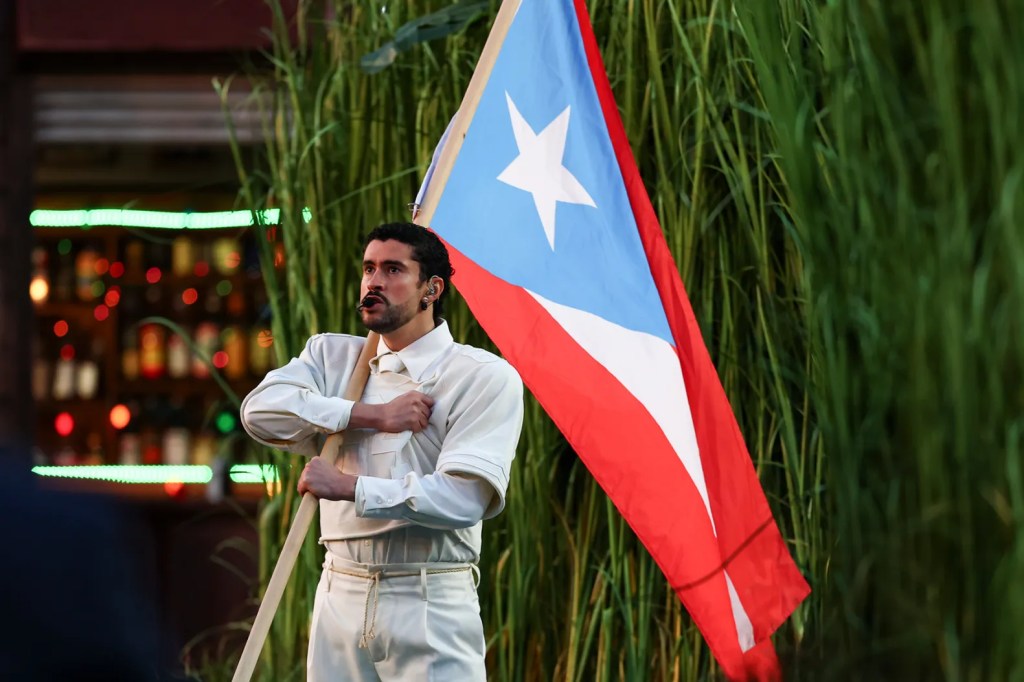
Bad Bunny ended his Super Bowl performance carrying the 1895 flag of Puerto Rico, representing the island’s history and resistance against colonial rule (Photo Credit: Rolling Stone).
Still, the message extended beyond Puerto Rico. After saying “God Bless America,” Bad Bunny proceeded to name countries across North, Central, and South America.
“He’s trying to say that America isn’t just the US,” said Valencia. “South America, Central America, and North America all play a role in what is defined as America.” The moment emphasized that the continent is made up of many nations, cultures, and people.
This idea was reinforced with the diversity of dancers who represented nations across the Western Hemisphere and through the football he held up, reading, “Together We Are America.” The message pushed back against US nationalism at a time when immigration dominates political discourse.
Still, that message was not just reinforced through visuals. The decision to perform solely in Spanish sparked controversy among some viewers, while others defended the choice. “America does not have an official language, and Spanish is [one of] the most spoken languages in America. So I think it makes a lot of sense that this was in Spanish,” said Sainath.
Abhay Polavajram (12), however, questioned whether it was the right venue for an all-Spanish performance. “The Super Bowl is the most watched television event in the US,” he said. “I wouldn’t have had a problem if half was in Spanish and half in English, but the whole thing being in Spanish was kind of weird.”
While Polavajram did not oppose the message itself, he emphasized the importance of context. “There’s nothing wrong with sending a message, but there should be a time and place,” he said. “The Super Bowl is mainly for entertainment.”
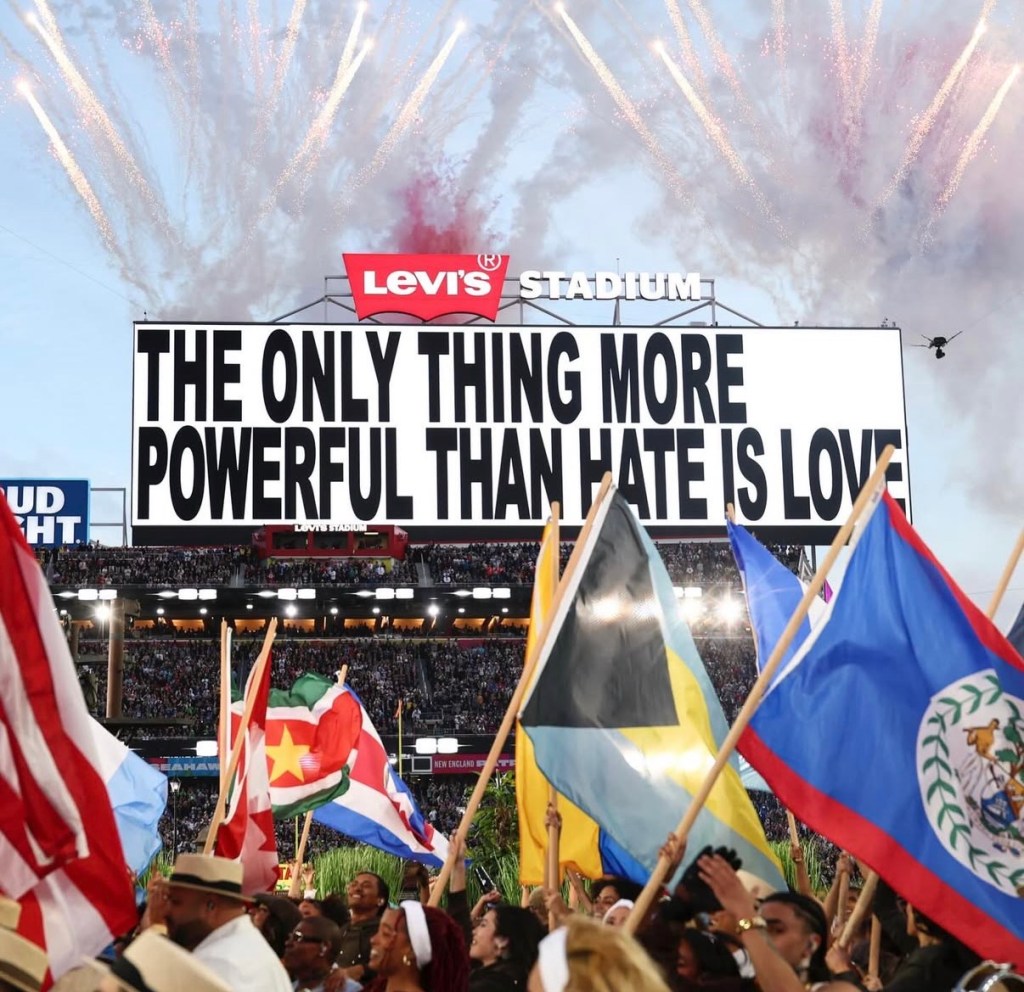
The message, “The only thing more powerful than hate is love,” was displayed on the screen as Bad Bunny concluded his performance with his hit song, “DtMF” (Photo Credit: Variety).
Sra. Reid saw the all-Spanish performance as a conscious choice of inclusion. “It reached such a diverse population—not only within the United States but outside of it,” she said.
Sainath argued that the message of unity felt extremely timely given the context of current ICE raids. “Due to all the problems and controversies that are happening with ICE right now deporting people and taking them away from their families, it’s more important now than ever to be spreading messages of togetherness.”
That theme was emphasized by the banner in the back reading, “The only thing more powerful than hate is love.” Rather than serving as an explicit political statement, the message functioned as a broad expression of unity that many interpreted through their own perspectives. Yet, as Sainath said, “Even the message of spreading love is political today.”
Whether viewers interpreted the halftime show as activism or cultural representation, the reaction itself emphasized how intertwined culture and politics have become.
On a stage designed for mass entertainment, Bad Bunny’s performance did not explicitly promote a candidate or party. Instead, it asked a broader question: who gets to define America?


 Eagle Era
Leave a comment