Young activists across the community demand accountability
By Sachi Ladole, Kaitlyn Liu, & Tiffany Notice
Over the course of several weeks early this year, students across Alameda County have organized walkouts protesting the recent actions of US Immigration and Customs Enforcement (ICE).
Students marched, delivered speeches, and coordinated walkouts to show support for immigrant families. While many participants described the demonstrations as empowering, others questioned their effectiveness at balancing the importance of students’ voices alongside school policy.
After a first walkout on January 20th, students at AHS returned on January 30th for another demonstration to protest ICE, this time with more planning and organization.
Unlike the first walkout, which was largely spontaneous, the second was intentionally structured according to student organizer Eason Chang (10). “I saw the sheer number of people at the first walkout,” they said. “And I thought, since the wave is still going, there should be another one.”
Information about the event circulated widely through reposts of flyers on social media and word of mouth. By brunch on January 30th, crowds of students had assembled by the flagpole, ready to show their frustration.
The demonstrations began as the students walked in a loop around the front of the school along Fremont Boulevard, with handmade signs and posters raised high. Cars passing by honked with some drivers waving in support—adding to the energy of the demonstration.
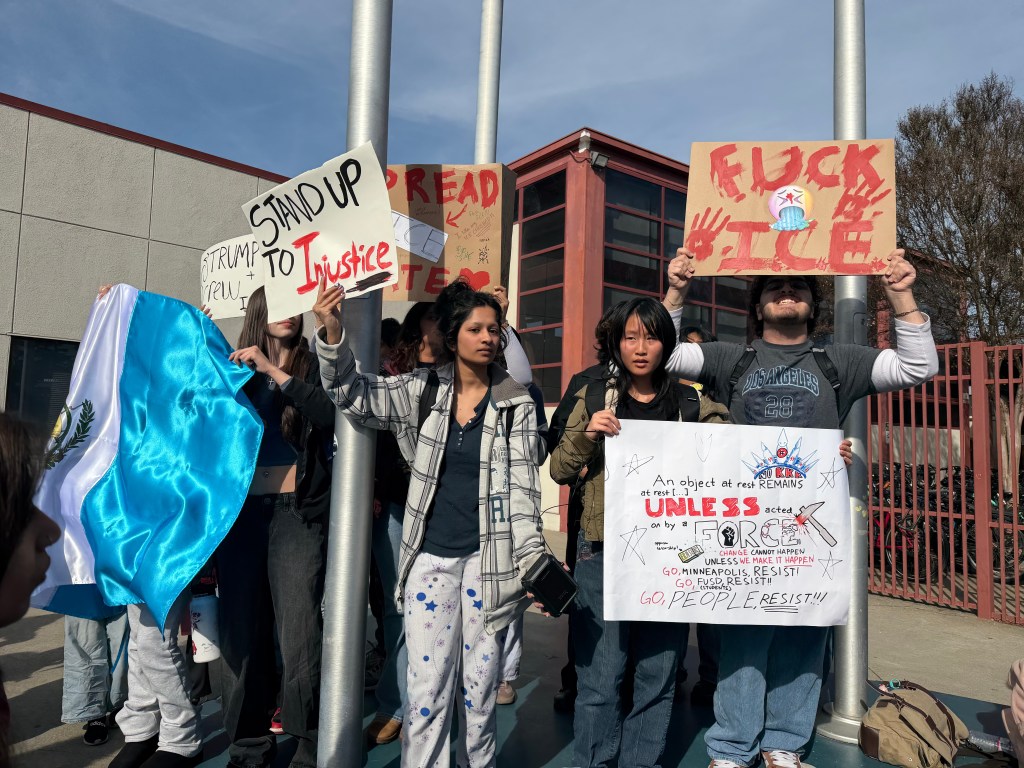
During the second protest, many carried signs high, displaying messages about immigration enforcement, solidarity, and support for families affected by ICE policies (Photo Credit: Sachi Ladole (9)).
Olivia Haynes (11), a student at AHS, made and distributed posters to peers and attempted to raise awareness through her social media platform. “It genuinely sickens me to know that there are people out there who think [ICE’s actions] are okay. I will continue to speak up and fight for what’s right. The more the word spreads, the closer we will get to change.”
According to a statement on their website, ICE says its mission is to “[p]rotect America through criminal investigations and enforcing immigration laws to preserve national security and public safety.”
Yet, at these protests, several students pushed back against these statements, stepping forward to deliver speeches about immigration policies and their effects on families in the community.
Towards the end of FLEX, the protesters held a brief moment of silence for individuals who have been fatally shot by ICE agents or died in custody. Students stood together near the flagpole, holding their signs for several minutes. Before the bell rang, organizers encouraged participants to sign a poster in solidarity with those affected.
How students reacted across multiple schools
AHS was only one of the many schools that participated in protests. From Mission San Jose HS (MSJ) to James Logan HS, schools across Alameda County were similarly active about their concerns regarding ICE.
Students at Irvington HS were especially passionate about recent ICE activity. Avni Xena, who played a large role in organizing the school’s walkouts, stated that the walkout was led primarily by students. Personally, Xena aided in connecting to other students via social media, utilizing students’ online presences to broadcast information.
Xena also had the opportunity to give a speech in front of her peers, where she displayed her passion. She stated, “We do all have one tool we can use to keep justice alive, and that tool is empathy. Empathy is refusing to let people become statistics. And right now, that matters more than ever. Not everyone can vote or protest, but everyone can refuse to be numb.”
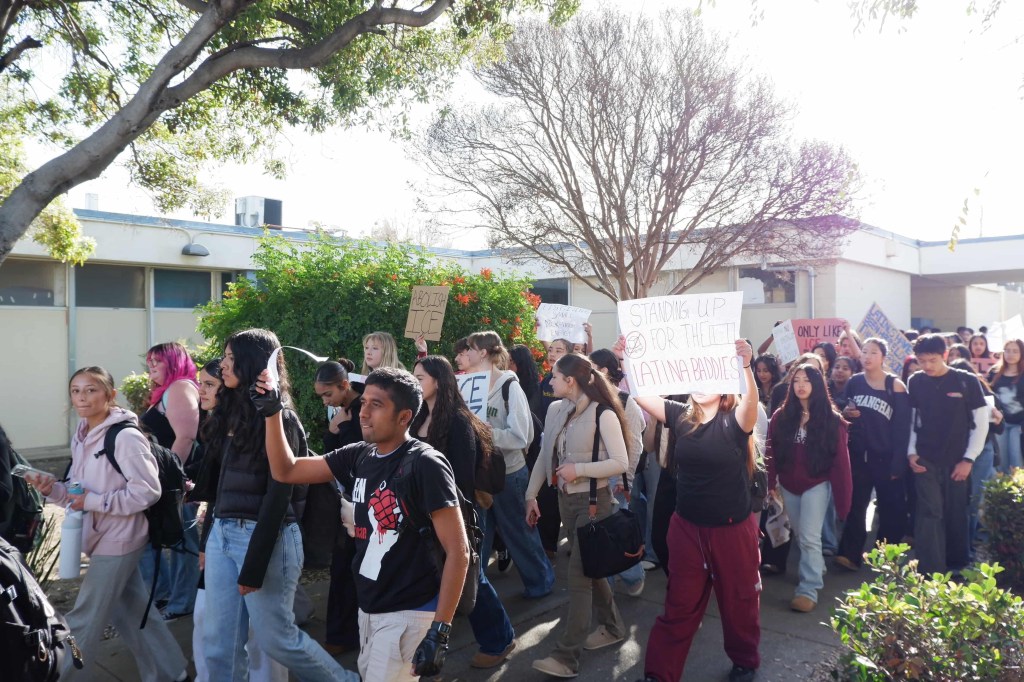
“We coordinated with student leaders, planned the timing carefully, and made sure everyone understood that the demonstration would remain peaceful and respectful,” said Xena (Photo Credit: Nivi Shome (11)).
Despite her opposition towards ICE, Xena also stressed the importance of understanding, refusing to judge people who did not attend walkouts. “I think that everyone has the capacity to care for innocent people. You don’t have to protest, but I urge everyone to show empathy and love,” she said.
Kelly Shi, a student at MSJ HS, described walking out to the front of her campus alongside some of her friends who had signed up to deliver speeches. In the days leading up to the protest, Shi described how students took the initiative to create powerful school chants that reflected their disapproval of a long history of authoritarianism in the US. “It was pretty empowering because we were chanting some of the scripts they gave us pre-walkout, such as ‘No ICE, No KKK, No Fascist USA.’”
The future of student activism
While the recent walkouts have been fueled by student outrage and disagreement over ICE, many question their efficacy and place in an educational setting. District leaders and school officials have had to strike a balance to allow students to express their 1st Amendment rights while keeping them safe and in school.
Ms. Strausbaugh, the principal of Thornton Middle School, said, “School administration encouraged students to meet Principal Strausbaugh in the small gym to provide an opportunity for their voices to be heard and to brainstorm some ideas about how they could protest in a way that would also comply with all school rules.”
At AHS, Amnesty International Club President Evangeline Bloom (11) held an event with a similar intention. On February 5th, the club hosted a letter-writing event aimed at sharing the sentiment against mass deportations with government officials.
The event gave students an alternative way to voice their concerns. Bloom was pleasantly surprised by how many people participated in the walkout—to her, the dedication was apparent. “That was our largest event. [Students] definitely took it in a positive way and saw it as an opportunity for them to extend their voices.”
FUSD superintendent Zack Larsen echoed this sentiment, saying, “Our goal is to support civic engagement while ensuring every student has access to the instructional time they need to succeed.”
Larsen said, “Our focus remains on supporting consistent attendance, student safety, and instructional continuity so that any disruptions are minimized.”
Despite the passion shown during the walkouts, the reality of student advocacy remains challenging. Now, more than a month after the first protest, student participation has declined for recent events, beginning with the low turnout for a third protest. The Instagram account made by ASB presidents in the area, @Tri-City Against ICE, was formed after the first two protests as a way to keep the momentum going. However, miscommunication and short notice for the planned third protest ultimately led to its cancellation.
ASB President Ayush Sharma said, “We acknowledge what went wrong, but we also understand the admin’s perspective, and we just try to accommodate. Moving forward, we’ll figure something out that everyone can participate in.”
Bloom reflected on the walkouts, expressing the importance of the momentum to continue. “What I hope to see is that students continue to care—they’ll continue to stay passionate about this issue and continue to fight. It’s so easy to lose hope when you’re advocating for change.”


 Eagle Era
Leave a comment