A TPUSA speaker, a protest shutdown, and a federal probe
By Anthony Liu
When a Turning Point USA guest speaker arrived at UC Berkeley in mid-November, the event was interrupted by a protest that grew loud enough to shut it down. The demonstrations sparked a federal civil rights and campus safety investigation, putting Berkeley at the center of a national conversation about how universities should balance security, student activism, and free speech. For high school students watching from the outside, it was a preview of the debates they’ll inherit the moment they step onto a college campus.
TPUSA, the conservative organization behind the event, is known for bringing politically-charged speakers to schools across the country. Its appearances have, at times, resulted in counter-protests from students, which can draw increased attention to the events themselves. Berkeley’s protest wasn’t unusual in that sense. What made it stand out was how quickly it escalated and how the federal government chose to get involved afterward.
A college student who chose not to be named said that while he did not personally attend the protest, several of his friends did, and he has learned a great deal about it. “People have been arguing over political stuff for years,” he said. “If the university invites a controversial speaker, they can expect a reaction.”
From what he heard, tensions rose faster than campus officials anticipated. “You don’t need to be a security expert to know that things could get messy,” he said.
For Rishab Sehgal (12), the protest is a reminder that student activism is woven into campus life. “Protesting is part of how students speak up,” he said. “You can support free speech and still care about safety, but the school has to plan for both.” He thinks the university could have done more to keep the event calm. “It shouldn’t come as a surprise when strong reactions happen,” he said.
Federal authorities are investigating whether UC Berkeley met its safety and reporting obligations under the Clery Act, a law that requires colleges to track, report, and prepare for threats on campus. Sehgal saw the investigation as a warning. “It shows that the government is paying attention to how schools handle these moments,” he said. “That can help with accountability, but it also raises questions about how far that oversight should go.”
The college student saw the involvement as mostly practical. “It’s not so much about shutting down protests,” he said. “It’s just checking if the university did what it was supposed to do.” He’s not convinced student activism will be harmed, and he doesn’t think that would necessarily be a bad thing. “College is for learning. If people want to protest, there are plenty of other places to do that,” he said.
For high schoolers who will soon face similar situations themselves, UC Berkeley’s clash is more than a one-off headline. Students may express their views, but campuses also have a responsibility to maintain safety. When these considerations overlap, questions arise about how boundaries should be defined. As Sehgal emphasized, “I don’t think we should conflate the two—protest and violence. No matter what opinions are being said, violence is never the answer.”
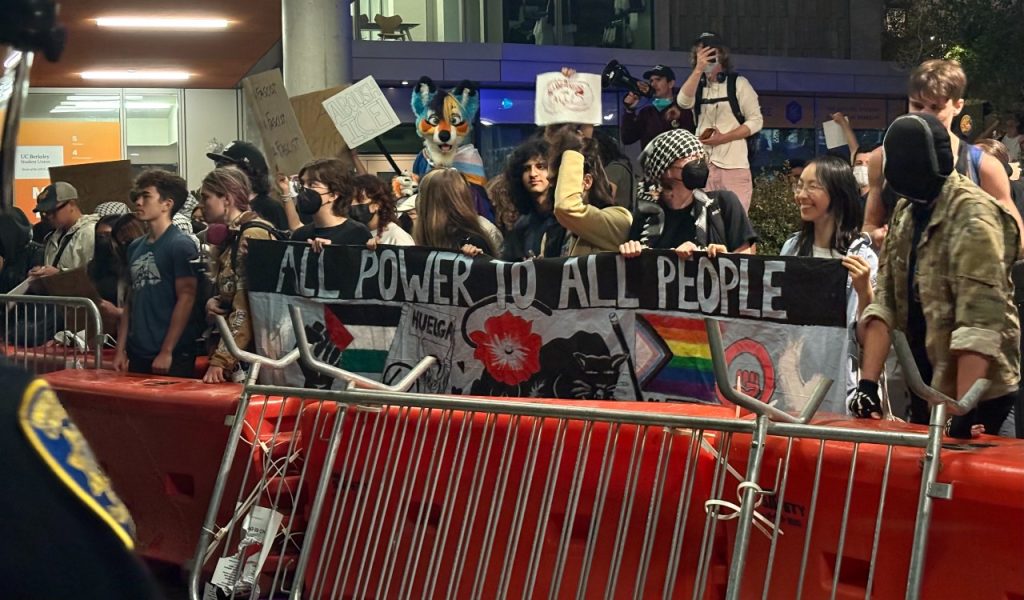
Students chanted and banged on the barricades outside UC Berkeley’s Zellerbach Hall, where the Turning Point USA event took place (Photo Credit: Chrissa Olson).

 Eagle Era
Leave a comment