With work and pressure comes less motivation for juniors
When students hear the suffix “itis,” senioritis—the senior-year experience of counting down the days until graduation and slowly checking out of school—is usually the first thing that comes to mind. While senioritis is widely acknowledged and even joked about, another form of burnout often goes unnoticed: junioritis. Unlike seniors, juniors are expected to push through exhaustion while being told that junior year is the most important year of their high school career.
Junior year carries a unique weight. Students are expected to take on some of the most challenging coursework of their academic career while balancing extracurriculars, leadership roles, and the pressure of college preparation. For many juniors, there is little room for mistakes, as they are constantly reminded that this year determines their future. This combination of pressure and expectation often leads to burnout that is rarely addressed.
For many students, junioritis begins halfway through the school year, once the initial spark fades and workloads increase. “Midway through the year taking those really hard classes, you start to feel a lot of burnout, and it drives down your motivation,” said Ikjot Bali (11).
She explained that the academic rigor of junior year plays a major role in this burnout. “Focusing on APs feels the most mentally draining because a lot of them require constant studying compared to previous classes,” Bali said.
As motivation declines, students’ study habits and daily routines often change. Bali shared that she began the year feeling confident and hopeful, but that motivation has since started to deteriorate. On days when junioritis feels overwhelming, she turns to coping strategies to manage her workload. “I’ll write out all the work I have to do, and I’ll take an insane amount of breaks,” Bali said. She also noted that while some teachers acknowledge the pressure juniors face, others underestimate how mentally draining the year can be.
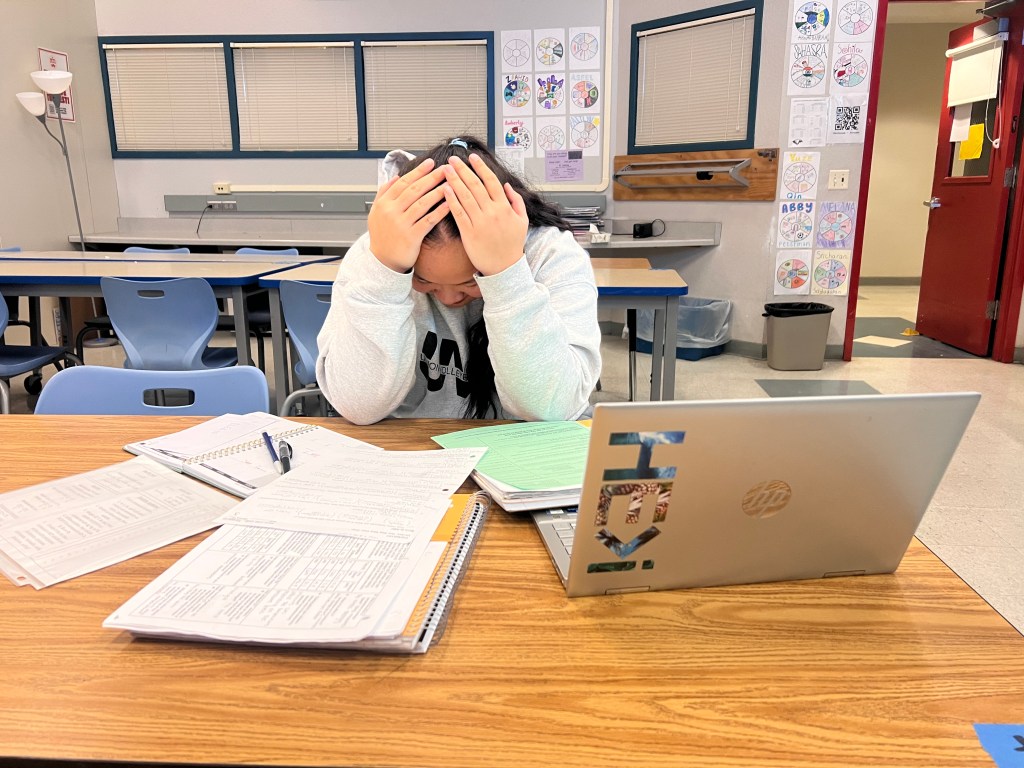
Overwhelmed by assignments and deadlines, Elea Yangorin (11) experienced the mental fatigue that defines junioritis (Photo Credit: Marjan Nabizada (11)).
However, junioritis does not affect every student in the same way. Vraj Shah (11) explained that prioritizing personal well-being has helped him manage the stress of junior year. “Junioritis has not affected my sleep schedule or mental health,” said Shah. “I prioritize these things before schoolwork, so I am able to get enough sleep and focus on myself, even if it sometimes comes at the expense of a bad grade.”
Shah believes that college expectations significantly contribute to junioritis. “High GPAs and AP classes being normal to colleges does increase junioritis,” Shah said. “So many students bite off more than they can chew and compromise parts of their life that are more important, such as their diet, sleep, and family.”
Shah also pointed out that peer pressure can make burnout worse. “No matter how much you do, someone will always be doing more,” Shah said. He added that this mindset causes burnout to set in faster.
Despite the pressure, both students emphasized the importance of self-awareness and balance. Bali shared that organization helps her manage stress. “I have a calendar and I lock it. Priorities are really important to me, so my schoolwork comes first and then my extracurriculars,” Bali said.
Maintaining his own personal boundaries has helped Shah stay grounded. “I know my limits, and I try not to compare myself to other students—which makes my capabilities shine,” Shah said.
While senioritis continues to dominate conversations about burnout in high school, junioritis quietly affects many students long before senior year arrives. Recognizing junioritis not only validates the experiences of juniors but also opens the door for more supportive academic environments.
As schools, colleges, and families continue to emphasize high achievement and as students place increasing pressure on themselves, acknowledging the mental and emotional toll of junior year may help students find healthier ways to succeed without sacrificing their well-being.

 Eagle Era
Leave a comment