Why the smarter way to manage phones in class is implementing boundaries instead of bans
By Anthony Liu
As school districts across California debate whether to ban student phone use, many, including FUSD, have opted to leave the decision to individual schools. While some campuses are moving toward stricter policies, AHS has chosen not to implement a full phone ban this year. The discussion centers on whether smartphones are supporting student learning or undermining the classroom environment.
There is no denying that phones have become essential to modern student life. They are used for communication, navigation, and safety—and for many students, being separated from a phone feels unrealistic.
Yet, students themselves acknowledge that unrestricted phone use in class is a problem. Sophia Huang (12) recognizes the challenges of phone usage in class but still believes that a full ban isn’t necessary. “I believe non-phone usage during class is beneficial, but phones should not be completely taken away,” Huang said. “Students should still have it on them for safety uses, just in case. Teachers should just reinforce phone policy rules during class.”
Huang’s perspective reflects a growing consensus among students. The issue isn’t black and white—there’s more to consider than simply allowing or banning phones. The real focus is on setting clear boundaries that help students stay engaged while still keeping phones accessible for safety and practical purposes.
While phones serve legitimate purposes, they are often disruptive during instruction. “Phones are distracting in class,” Huang said. “In one of my classes, my teacher banned phone usage. Everyone seems to be more alert and actually doing the work, working with neighbors and asking questions.”
Allowing phones during class makes it nearly impossible for students to stay focused. “When students have their phones, they’re usually not paying attention,” said Aden Zhang (11). “Even if they start class focused, it’s really easy to get distracted once you check your phone.”
Phones can end up disrupting the learning environment, making it less likely that students engage with academic material. “If phones weren’t allowed during class, students would be more likely to ask questions and actually listen,” said Zhang. “It would make classes feel more productive instead of everyone staring at their own screen.”
Still, safety remains a valid concern, as phones allow students to contact help during emergencies and stay connected throughout the day. Any restriction should therefore account for this reality. “If there’s any danger, students need their devices to call for help,” Huang said.
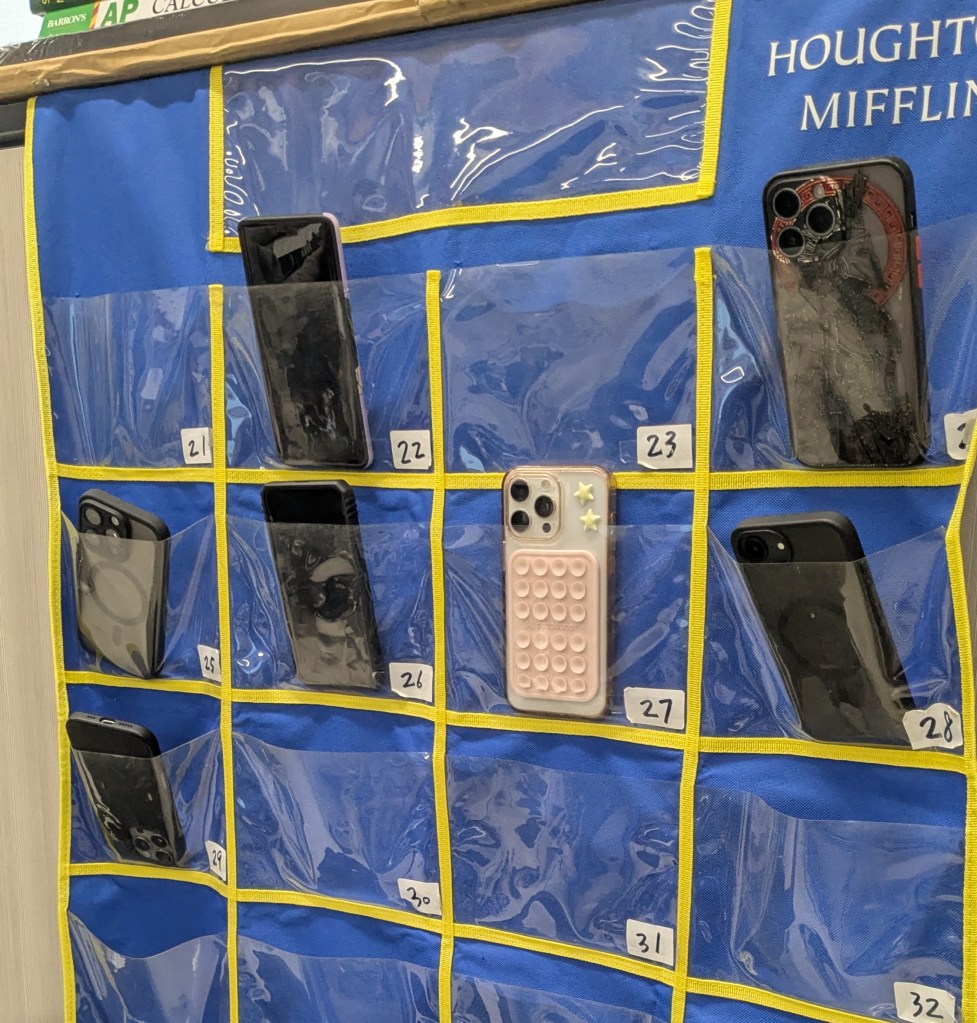
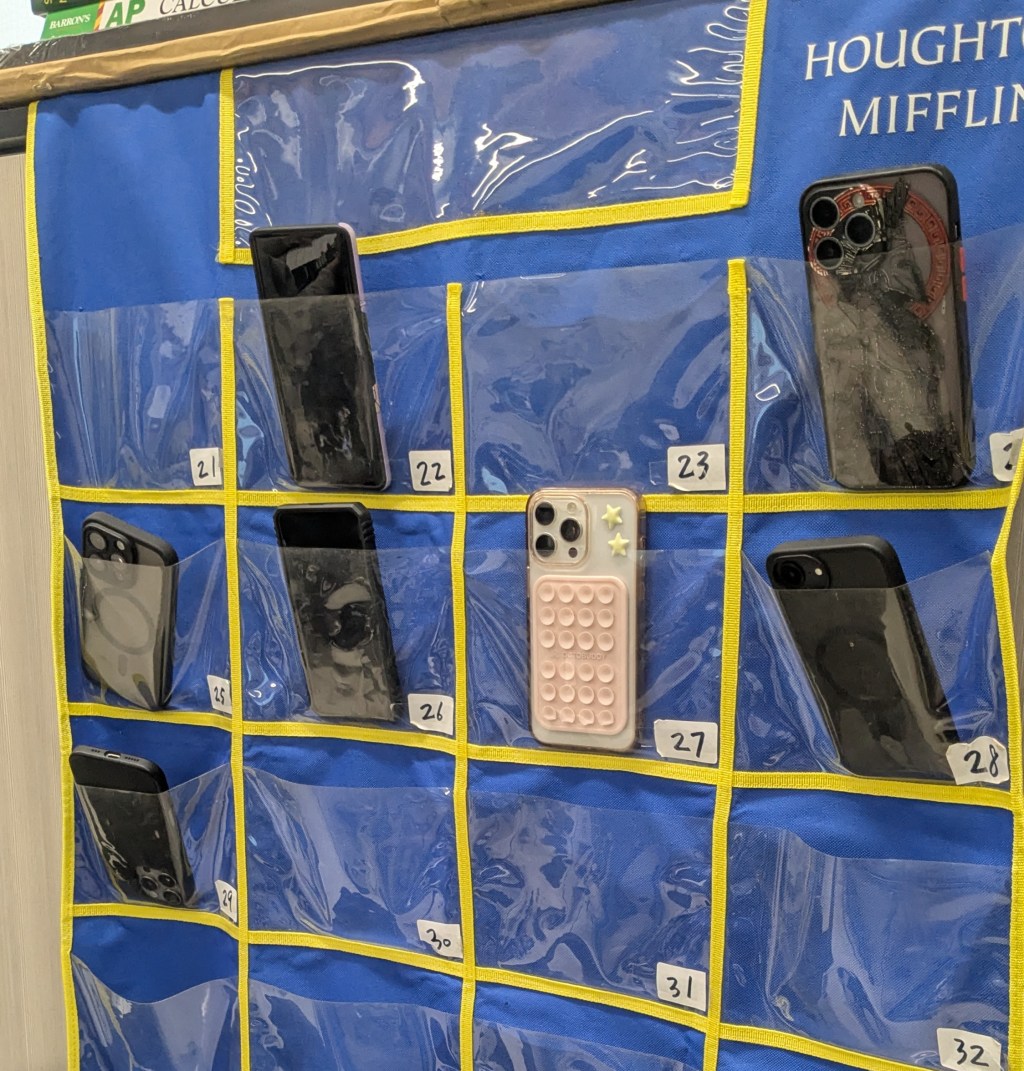
In Ms. Yu’s Accelerated Geometry/Algebra 2, AP Statistics, and Intro to Statistics classes, students’ phones are temporarily confiscated in order to enhance focus in class (Photo Credit: Anthony Liu (12)).
Beyond safety, learning to manage phone use now can also prepare students for life after high school. “A phone ban could prepare students for college and even the workplace,” said Huang. “You just can’t be on your phone all the time when you actually graduate high school.”
Phones are not inherently harmful, but in classrooms, they can become overwhelming distractions rather than learning tools. The ultimate goal should thus be to strike a balance that limits distractions while teaching responsibility. The solution is not an outright ban, nor ignoring the problem altogether. Schools should take a firm stance on limiting phone usage during instructional time, teaching students to disconnect when the time comes to do so.




 Eagle Era
Leave a comment