The causes, effects, and solutions to the FUSD budget deficit
By Angella Li, Ananya Pangarkar, Lisa Shokoor
From teachers who are unable to afford supplies to students missing out on opportunities that they’re not even aware they have, funding has been one of FUSD’s biggest challenges.
Over the past decade, FUSD’s funding has been steadily decreasing compared to the state average. This has caused discrepancies in the funding between departments in AHS, with some struggling more than others. AHS is not alone in this issue; the district is projected to experience funding problems that may lead to reductions in certain resources. Potential solutions, like changing the funding formula to be more representative of different districts and their cost of living, have been proposed to help Californian schools.
The FUSD budget is derived from the California Local Control Funding Formula (LCFF), which gives money to districts depending on their daily attendance, otherwise known as Average Daily Attendance (ADA). This translates to roughly $65 every day a student attends. As chronic absenteeism increases, the revenue generated by the school decreases.
Budgeting through AHS
The impact of FUSD’s budget varies within AHS, with large discrepancies in the school budget’s ability to meet the demands of certain classes. Ultimately, this results in a shortage of resources for teachers and a lack of opportunities for students.
While the Visual and Performing Arts (VAPA) department currently receives Prop 28 funding designated specifically for arts and music, it still faces budgetary challenges. Ms. Mapelli, who teaches Sculptures and Ceramics, said, “I probably spent upwards of $1000 of my own money. I have been reimbursed for most of it, but the school district does not reimburse teachers for anything purchased from Amazon.”
Since staff are required to follow specific district guidelines for accepting donations from families, teachers are prohibited from sharing Amazon wishlists for extra supplies. Ms. Mapelli said, “I asked permission to send an Amazon wishlist for parents to donate supplies to the class. I was told no, but I feel like parents are more willing to donate when they know what it’s going towards.”
Despite struggles in the VAPA department, teachers in the science department find their budget to be sufficient. Mr. Benz, the science department chair, said, “The science department, one of the largest departments in the school, has a sufficient budget. We always ask for parent donations; parents think science is important, so they’re more inclined to donate to science.”
“I would like to see the district recognize the arts and athletics more, because those are the 2 [departments] I’ve noticed are the least funded, and I think you can learn a lot from both disciplines,” said Ms. Mapelli.
Budget constraints also have lasting effects on students. “We don’t have access to a lot of resources that could be putting us at an advantage,” said Anagha Sainath (12), a student working to tackle FUSD’s budget issues on a federal level through a policy paper on LCFF. “There’s a portal called Naviance that many schools use that’s really useful for seniors during college applications. Unfortunately, the district doesn’t really have the excess funds to spend on that.”
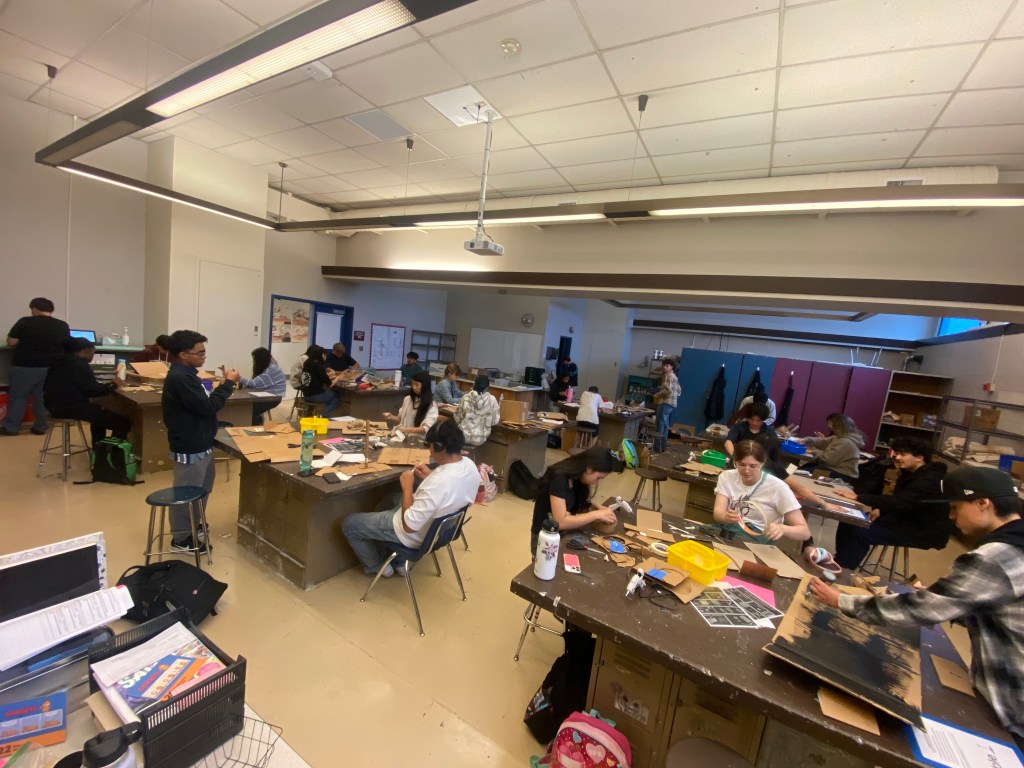
Ms. Mapelli’s ceramics class has faced many challenges as a result of insufficient budgeting, such as a lack of supplies. This required creative solutions to work around the funding problem. She said, “When I first started here, they supplied me with things like whiteboard markers, but they did not give me any clay or tools. Our first project was working with cardboard because that was something that students could find and bring to class” (Photo Credit: Ms. Mapelli).
The school budget affects each department differently, and combined with fluctuations in parent donations given to each department, it sometimes restricts VAPA classes significantly more than others. “A lot of money is put towards the sciences, and we’ve seen that art is typically the first thing that gets cut when budget cuts happen,” said Ms. Mapelli.
Belt-tightening in the district
As FUSD enters another budget cycle, district members and county officials warn that the issue is no longer a short-term budget adjustment, but a structural problem with lasting consequences.
The district’s budget concerns were formally acknowledged in January, when the Alameda County Office of Education (ACOE) reviewed FUSD’s 2025-26 First Interim Budget Report. The district is expected to meet its financial obligations in the near term, but the county raised concerns about declining enrollment.
Enrollment projections included in the review show that ADA is expected to decrease from 31,410 students in the 2025-26 school year to 30,660 by the 2027-28 school year. As enrollment declines, district leaders warn that the funding model magnifies the impact; through LCFF, districts lose revenue when students are absent. Sainath explained, “Excused and unexcused absences alike count against our funding. The school loses money with every person who’s not in a seat.”
Bobbi Parry, a member of FUSD’s Facilities Advisory Committee (FAC) and Citizen Bond Oversight Committee, said this approach fails to reflect the actual cost of operating schools. “I think it should be based on enrollment rather than attendance,” she said. “We know that teachers give homework packets, and that school secretaries have to see why students were absent. There’s a follow-up that has to happen that we’re not getting funded for.”
Benjie Craig, a volunteer on the FAC, noted that FUSD’s challenges are structural. “There’s a lot of districts around us that have the same problem,” he said. “Costs and salaries are going up, but there aren’t as many families around here, so there’s fewer students and less revenue.”
According to the First Interim Review, FUSD is facing deficit spending of $11 million in 2025-26, $9.5 million in 2026-27, and $8.9 million in 2027-28. If unaddressed, these deficits could reduce the district’s ability to maintain required reserves.
Parry said that many reductions had already been made over the past decade, leaving few options remaining. Some services have already been shifted off the general fund, including busing and library media technicians.
This pressure to cut spending is further complicated by the district’s approach to financial reserves. “Most school districts are supposed to keep a reserve fund of about 2-3% of their overall budget to help the school district weather a financial problem. Our school district likes to keep 10% of the budget,” said Mr. Howard, an English 10 Honors and Mythology/Folklore teacher and part of the executive board of Fremont Unified District Teachers Association (FUDTA). “If we’re always planning for an emergency and not for the kids who are currently in the school system, then these kids might as well be the ones in the emergency because they’re not getting that money.”
Ultimately, county officials have made it clear that maintaining long-term financial soundness will require challenging decisions. There still lies a lot of uncertainty regarding spending reductions. “We run very lean,” Parry said. “I don’t know where it’s going to come from.”
The million-dollar question
While much of the conversation is focused on losses, district officials are trying to reform staffing adjustments and new formulas that will distribute money more efficiently.
Since FUSD is a large district with 41 schools, implementing adjustments to the budget takes time, making responses to financial challenges more difficult. FUSD Budget Director James Arcala said every single year, the district is deficit spending by around 1 million dollars.
He said, “The majority of our expenditures in our budget—around 85%—goes towards people and the 15% pays for utilities such as electricity, gas, water, and school supplies.”
While discussing solutions, Arcala emphasized that staffing reductions were necessary to maintain stability in the budget. He said the district had to reduce staff in order to stay solvent for the next 3 years.
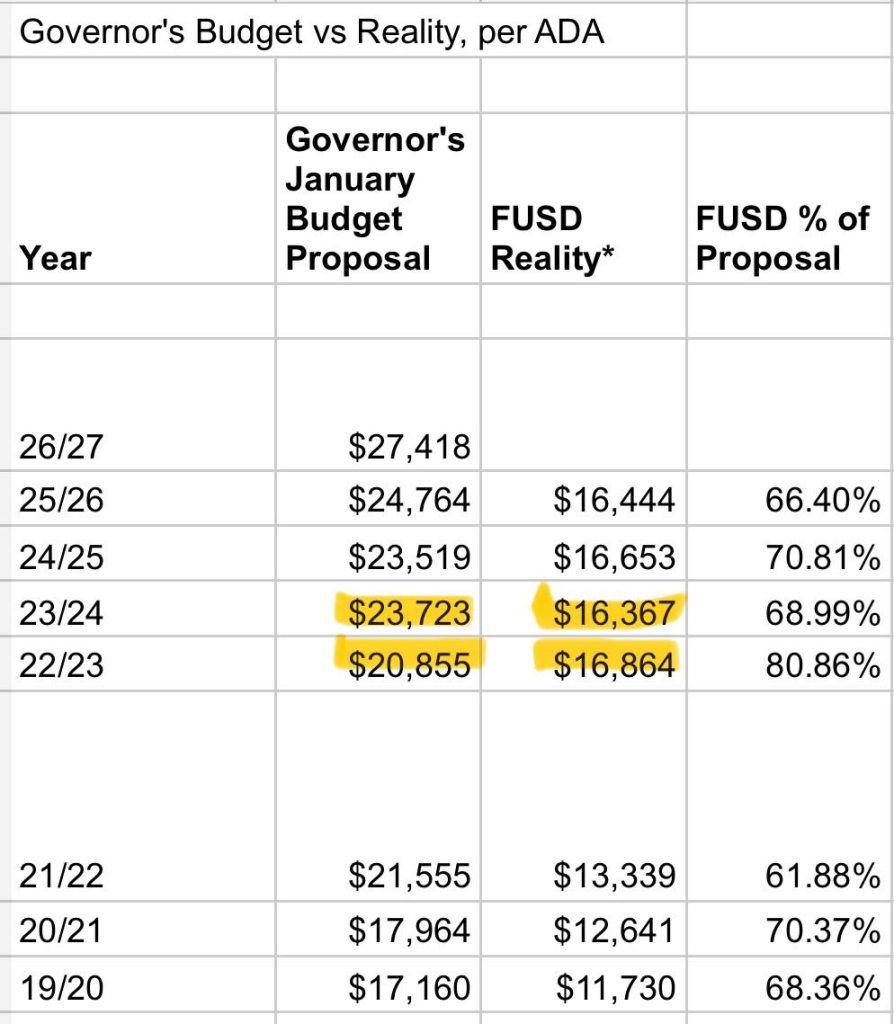
The proposed fund solution with a $20 million cut would cut out expenditures in the next 2 school years. “We did a big budget solutions plan and implementation the prior year in order to balance the budget, so we’re able to stay solvent,” said James Arcala (Photo Credit: FUSD).
One solution that Arcala mentioned was a reform in a classified staffing formula due to a drop in enrollment between pre-COVID and now. He emphasized that it was important that the district developed a formula where they collaborated with other districts to figure out a fair business practice plan.
In addition to budgeting strategies, the district is advocating for changes to the state’s Cost of Living Adjustment (COLA) which helps ensure public pensions and school funding reflects the expenses of an area. The COLA is the same statewide, regardless of the region or county, making it unrepresentative of each district’s unique cost of living.
Arcala explained that the district has been doing some work with local politicians to emphasize the need to revamp COLA. “If you’re in San Francisco, your calculated COLA should be based on your region and how inflation goes up, but [right now] it’s the exact same in Eureka. We’re arguing that the COLA should be region-based to account for inflationary factors that impact high cost areas.”
As FUSD continues to navigate an ongoing financial crisis, many district officials are working to fix problems with budget constraints and long-term planning. Despite these difficulties, there are initiatives that could supplement local school funding moving forward. Until then, officials have to budget based on what they know and what the current law constitutes.



 Eagle Era
Leave a comment