Concerns over recent ICE activity spur conversations on student activism
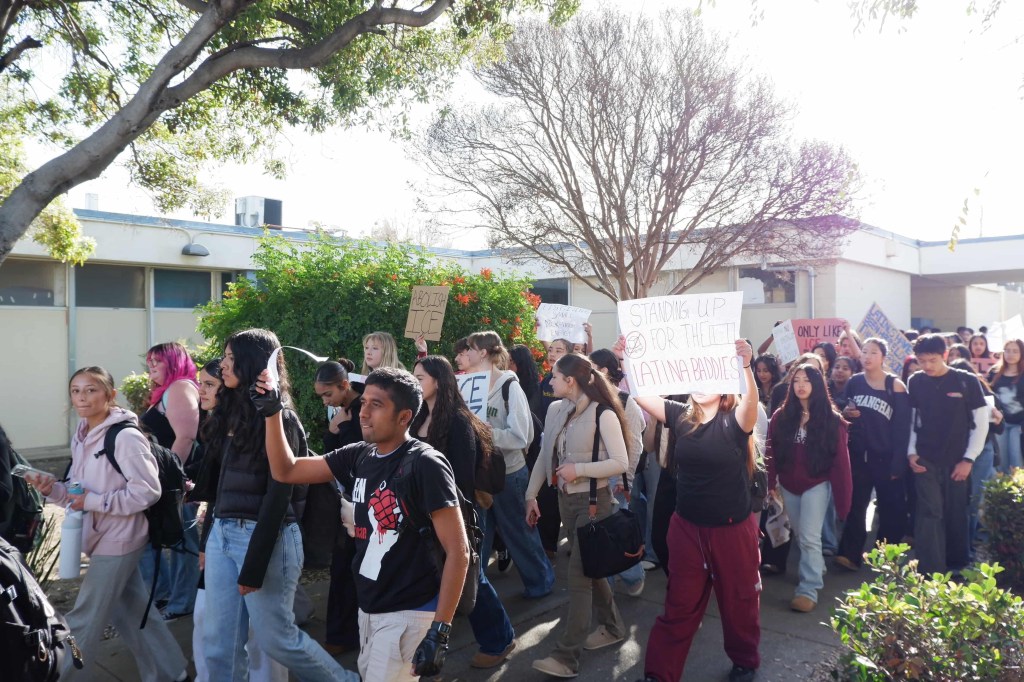
On January 20, many students participated in the nationwide Free America walkout, protesting the actions of U.S. Immigration and Customs Enforcement (ICE). These protests were spurred by concerns over unjustified use of force and deprivation of due process—specifically in response to the fatal shooting of Renée Good by an ICE agent earlier in January. The walkout at AHS began at 2:00 PM; most students returned to class by 2:30 PM, while others left campus entirely.
Students gathered near the flagpole at Gateway, covering the pavement with chalked slogans and drawings protesting ICE. The walkout was not organized by AHS; rather, it was a part of a broader string of protests around the country. “It was a national walkout, so it was not something the school planned. I honestly didn’t know how many students, if any, would participate until around 2:00 PM that day,” said Principal Sharma.
While some participants described the walkout as a necessary call for reform and accountability, others criticized it as ineffective and inappropriate.
For many students, participation was driven by family backgrounds and political interests. Richa Mungara (12) said, “My parents are immigrants. To see what’s happening all over the country—it’s egregious. It’s terrifying.”
Eason Chang (10) helped publicize the walkout through social media. “If we didn’t do this, it would be like accepting the normalization of ICE coming to schools,” they said. “It would be like normalizing the oppression.”
Mungara described the protest as a response to what she believes are constitutional violations on the part of ICE. “There are no regulations on these things. There are no rules,” she said. “Everything happening is completely unconstitutional.”
ICE did not respond to the Eagle Era’s request for comment.
Mungara criticized teachers who did not permit students to participate. “To all the teachers who are not allowing their kids to leave class, I think it’s disgusting. You are teaching your kids the wrong things for being future adults,” she said.
The walkout sparked debate concerning its impact on the school day. “Any disruption to the regular school day results in a loss of instructional time,” said principal Mrs. Sharma.
Hadi Souki (12), however, pushed back against claims that the walkout was disruptive. “What’s more disruptive: an ICE agent coming onto campus and trying to take you, or kids standing up for what’s right for one day? And it wasn’t even the full day—it was half a period,” said Souki.
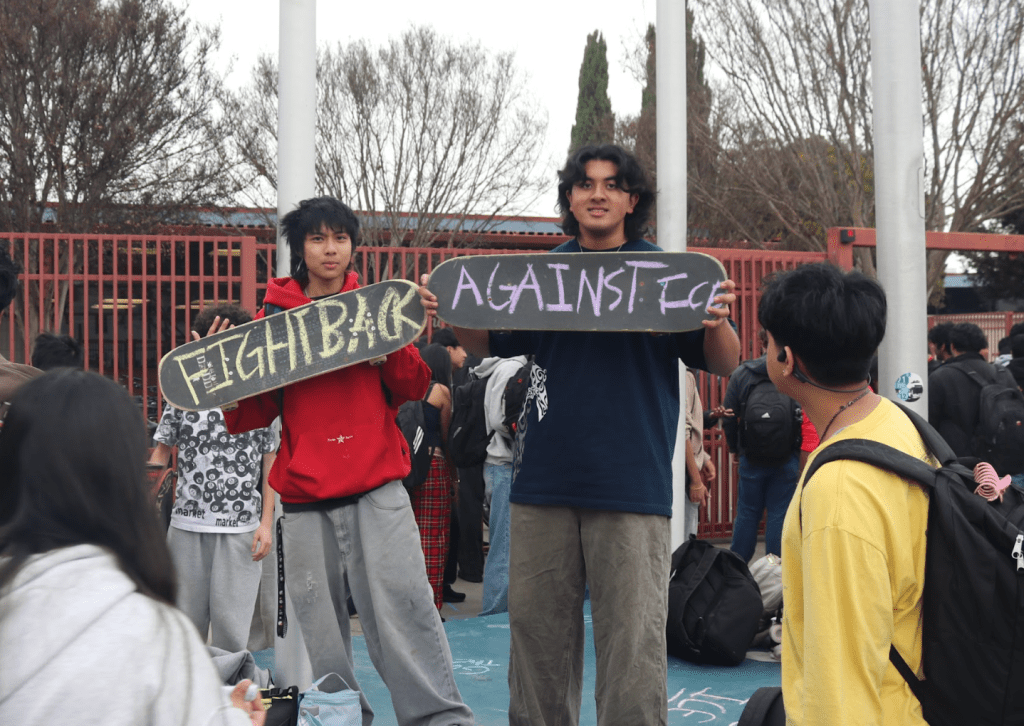
Aidan Encarnacion (12) and Mason Ledesma (12) displayed messages against ICE on their skateboards. “We are a school made up of an overwhelming majority of first- and second-generation immigrants, and we are a school full of extremely successful students. We are the absolute proof that immigrants are not only wanted, but also needed in our country,” said Mungara (Photo Credit: Aarnav Raamkumaar (10)).
Chang acknowledged that disciplinary consequences might be a concern, but they argued that the message of the protest outweighed the risks. “Sure, you may get punished. But a detention is better than seeing more people get detained,” they said.
However, not all students supported the walkout. Sricharan Sadagopan (12) said he supports ICE. “ICE is doing a good thing by doing what the voters asked for,” he said. “The point of ICE is to protect U.S. citizens from illegal aliens coming to this country. People are inside this country, and we don’t know anything about them. ICE has to deport these people back.”
Rohan Gandhi (11) offered a more moderate perspective. “[At first] I thought that most people wanted ICE to be abolished, but I think most people did agree with me that we just need better regulations,” he said. “We always need to work towards making sure the right people are caught, sent to jail, or deported in a humane and legal way. But completely abolishing an institution is never a solution.”
Sadagopan also criticized the execution of the protest, saying it lacked meaningful engagement. “I feel like no one really cared, and everyone just wanted to skip school at the end of the day, so that’s why it was ineffective,” he said. “If people actually cared, they would make signs and have conversations about why the protest was just.”
Some participants also agreed the walkout could have been better organized. “We probably should have made [more] signs and stuff too, which would have been much more effective,” said Souki.
Despite differing opinions on the effectiveness and execution of the walkout, many students see it as a starting point for ongoing civic engagement. Chang reflected on the broader impact of the protest, saying, “It gets students to explore their own views. It introduces them to the real world. We can slowly develop our activism using this as a building base.”


 Eagle Era
Leave a comment