The high-energy shopping tradition has shifted toward online deals and empty malls
For years, Black Friday has been marketed as the unofficial kickoff to the holiday season. What started in the 1960s as a post-Thanksgiving day when retailers’ profits went “into the black” has now become a national frenzy. By the early 2000s, it became synonymous with chaos—as crowds backed into malls before sunrise. But for many students today, the tradition seems to be fading.
Ruchita Deshmukh (12), a student who has been Black Friday shopping in-person since childhood, remembers the excitement vividly. “Before COVID, I remember Black Friday being such a big deal. There were lines around the block before the stores even opened,” she said. “They used to hand out coupons to the first 50 people in line. It felt like a crazy ordeal.”
Now, she said, that energy is gone. “After COVID, it feels like any other shopping experience. There’s nothing too special about Black Friday anymore.”
Deshmukh is not alone in feeling the shift. Many brands now stretch “Black Friday” into weeks of online sales. The COVID-19 pandemic changed consumer habits and pushed more shoppers to the internet. According to some students, that’s exactly why in-person crowds have shrunk.
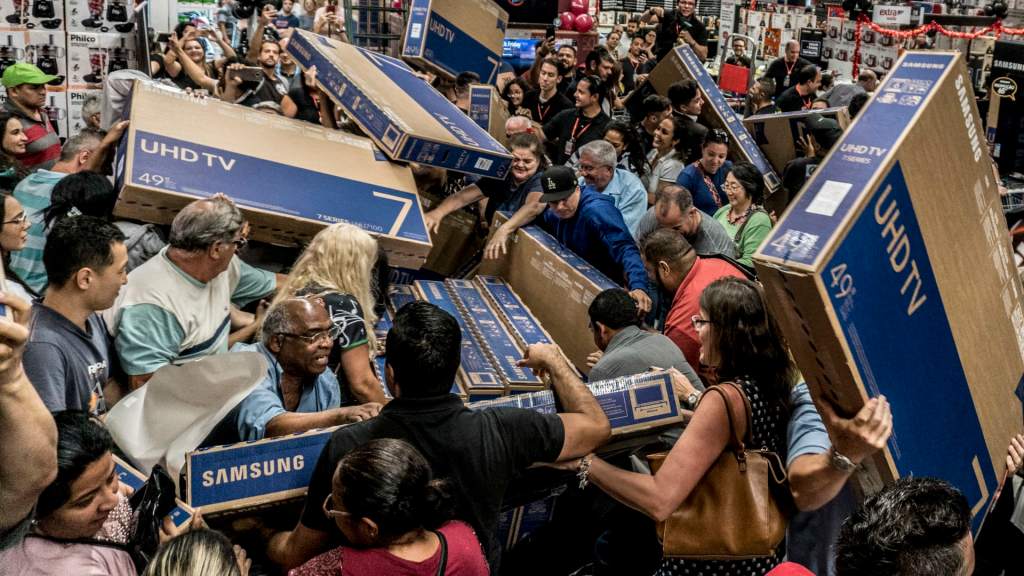
Shoppers were backed shoulder-to-shoulder as they scrambled to buy discounted TVs on Black Friday in 2018 (Photo Credit: CNBC).
Anagha Ravi (12), a student who shops almost entirely online, says the modern version of Black Friday is simply more convenient. “The deals online are basically the same as the ones in-store now, so it’s easier to just click ‘add to cart’ than to wait in line,” she said. “If anything, online sales start earlier, so you don’t have to fight anyone for the last item in your size.”
Ravi also points to the decline of local malls as a factor. “Half the stores at Newpark, the mall in Newark, are closed now. It’s easier to search online than drive all the way to Santa Clara to get to a decent mall.”
Newpark Mall was once a bustling shopping hub, home to big name stores such as JCPenney, Macy’s, H&M, and more. But over the last few years, most of its retailers have shut down, and much of the space has been replaced by a Costco. As a result, AHS students looking for a traditional mall experience now have to travel farther, to Westfield Valley Fair in Santa Clara, Great Mall in Milpitas, or Southland Mall in Hayward.
Still, Black Friday hasn’t necessarily lost its spark. It’s just changed. “There’s still excitement. Refreshing the webpage, watching prices drop, and trying to check out before everything sells out is its own kind of chaos,” said Ravi. “It’s not the same as running around a mall, but it’s still fun.”
As traditions shift and malls continue to shrink, the future of Black Friday might depend on what kind of experience shoppers value, whether that be the thrill of trying on clothes in person or the convenience of making holiday purchases from bed at midnight.
Regardless, it’s clear that Black Friday in 2025 doesn’t look much like the Black Friday that students grew up with.

 Eagle Era
Leave a comment