An overview of different fall cultural festivals
More than the leaves changing colors and the sun setting a couple of hours earlier, for many, fall symbolizes the beginning of a festival season full of ceremonies, family gatherings, and lots of laughter.
One festival that occurs during this season is Diwali, often referred to as “the festival of lights.” For Hindus, Diwali holds great significance and marks the arrival of the goddess Laxmi into their homes. To welcome her, people decorate their homes with diyas—small oil lamps made with clay—and rangoli, designs made from colored sand.
For many such as Aryanshi Gupta (11), the process of decorating the home with these colorful designs is especially meaningful. “Every year, my mom spends ages finding the most beautiful rangoli design online, and then we go outside and spend hours with our hands covered in sand making sure our rangoli looks perfect,” she shared.
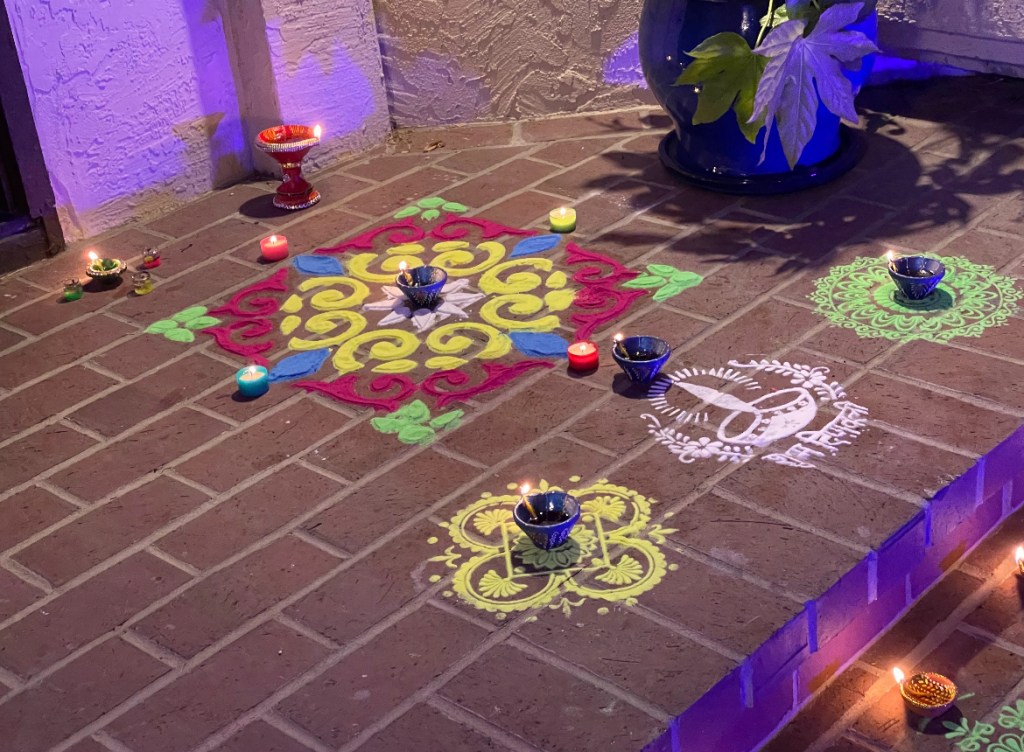
A photo of rangoli decoration with diyas outside a home. “Decorating my home is one of my favorite parts of Diwali; it makes me feel more connected to God in a way,” said Aryanshi Gupta (11) (Photo Credit: Suhani Thakkar (11)).
However, there’s more to Diwali than colorful decorations. Gupta explained, “Diwali is important to me because it is a festival that brings my family together with my friends, and I get to enjoy their light in my world.”
While Diwali focuses on celebrating the light in people’s lives, another festival, Día de los Muertos, or Day of the Dead, celebrates the light in those who have passed. For Mexicans, this festival is a way to honor their ancestors in a celebratory and exciting way, remembering those who have passed. As Dayana Ortiz (10) explained, “This festival is a part of my culture, and it helps me feel connected to my ancestors, so they know I still think about them.” For Ortiz, as for many other Mexican people, an important part of this festival is the tradition of making ofrendas, which are shrines for each loved one who was lost. “Our family members’ ofrendas have hats, and we put on their favorite dish or favorite drink. Then we show up and decorate it.”
The Korean holiday Chuseok, too, honors ancestors with food. As Gianna Lee (10) explained, “Most people usually visit their family’s shrines and give the favorite foods of those who have died. They also bow really deeply to show respect.” During this festival, Koreans dress in cultural clothing, eat special foods, and celebrate with their family. For Lee, her favorite part of the festival is eating all of the traditional dishes. “We eat rice cake soup. It’s called Tteokguk in Korean. It’s really long, and it gets sliced up and put into the soup. Each bowl of rice cake soup that you eat is supposed to add a year to your life.”
While all of these cultural festivals are spread throughout the world, the one known to most Americans is Thanksgiving. Thanksgiving is a time to be grateful and gather with loved ones to enjoy lots of homemade food. For Sierra Johnson (11), Thanksgiving is especially important for connecting her with those she loves. “It’s so fun getting to see my cousins, friends, and family that I don’t really see often. Thanksgiving definitely helps us bond.”
While all of these festivals are different in so many ways, one thing that remains the same throughout the globe is the value of family. As Johnson explained, “I think the most important part of this festival and really any festival is getting together with those you love and just having fun.”
 Eagle Era
Leave a comment