The Class of ‘26 finally takes the win amidst diminishing spirit
By Iniya Prabahar, Anthony Liu, and Jonathan Wang
A day before the rally, practices were turned into a storm of noise and confusion. The tinikling dancers stood in uneven rows, faces tight with frustration. PVC pipes clashed against each other as dancers tried to make five-foot poles work in place of bamboo sticks.
Choreographer Francis Garcia (12) paced along the sidelines, hands on his head, trying to figure out how to make the dance work without the traditional Filipino sticks.
The poles were too long to move, too heavy to lift, and every time someone tried to tap them together, the hollow thunk echoed terribly.
As the song switched, pairs scrambled to switch positions. PVC pipes scraped against the concrete, and Garcia winced, knowing the pipes needed to be returned.
A pole slipped, spinning across the floor. Another slammed down on the wrong beat, and a dancer’s ankle got caught mid-step. She stumbled forward, barely catching herself as her partner lunged forward to catch the pipe before it tripped someone else.
The pipes clattered, the dancers stumbled; yet, Garcia kept encouraging them, hoping that somehow, by the next day, everything would come together.
Spirit Week has long been a cornerstone of AHS tradition—a time when students set aside their academic pressures to celebrate school spirit and community. After three years of last-place finishes and fading enthusiasm, the Class of 2026 entered this year with something to prove.They faced low morale and a shrinking pool of participants—both to dance and to watch—as Spirit Week crowds have dwindled since the pandemic.
But for the Class of 2026, this year was different. Determined to end their high school journey on a high note, they rallied together to reclaim their spirit and rewrite their legacy.
“All you’d hear was ‘four for four, four for four’ from all of the other classes,” said class senator Naina Jain (12). “We had to bring up everyone’s spirit. I wanted people to be excited again, like old Spirit Weeks before COVID. That was my goal: bring back the hype.”
An unmoved crowd
While seniors rallied around redemption, not everyone across campus felt the same spark. Although Spirit Week is known for drawing large participation from students lining the bleachers and stands, many choose to sit out or go to the Old Cafeteria.
“During the rallies, there are always around 100 or so people sitting in the cafeteria or outside the gym. The plotlines and dances are not really polished, so I would rather not go,” said Timothy Lin (12), who often skips rallies.
Rallies generally consist of student-prepared dances, many of which celebrate different cultures. Still, some students feel left out when only a handful of those traditions are set on stage. “There were a lot of Tahitian and Indian dances this year. I feel like there should be more dances from different cultures,” said Jonah Sunny (10).
Lin echoed similar frustrations when he said, “I felt like I was watching the same thing, same dance, same choreography over and over again [each year]. For some, it can be a valuable experience, but I find it unnecessary.”
This sense of disengagement and unenthusiasm isn’t unique to Lin. Across campus, participation in rallies has slowly declined—a change that hasn’t gone unnoticed from staff. “It seems like it’s gone down since before distance learning. Our rallies used to be packed. Everyone took part; it was a tradition. I think that got lost when school shut down,” said Mr. Anderson, a Leadership teacher and Activities Coordinator at AHS for the past eight years. Distance learning left students feeling disconnected from school spirit, making it harder for them to feel motivated to be engaged.
Even after returning to in-person learning, the sense of detachment from Spirit Week did not completely disappear. Surrounded by the Bay Area’s academic pressures, many students prioritize doing homework for their classes, with Spirit Week taking the backseat. “I find making rally days closed Flex is a little frustrating, as I would rather use that time to meet with teachers or club officers,” said Lin.
Yet, a general trend of increasing spirit within the senior class—as students wish to seize their last chance to get involved and leave a mark before graduation—contributed to their enthusiasm to win. “Since freshman year, the attitude has completely changed. Spirit Week used to be the same small group of people every year, but now it’s so much more diverse. Everyone wanted to join in,” said Orna Paul (12), a dancer who has taken part in Spirit Week all four years.
Shreya Pawar (12), a student who never participated in Spirit Week until this year, said, “Going into senior year, I told myself that I was going to do every single event possible because it’s the last time we ever get to experience this.”
Making the magic happen
“Planning actually starts back in the last school year,” Mr. Anderson said. “It depends on when the football games are since the themes and rallies usually tie into those.”
For Mr. Anderson, planning Spirit Week is like running a small city. Each competition, game, and rally has to move in sync. “It’s a lot of moving parts,” he said.
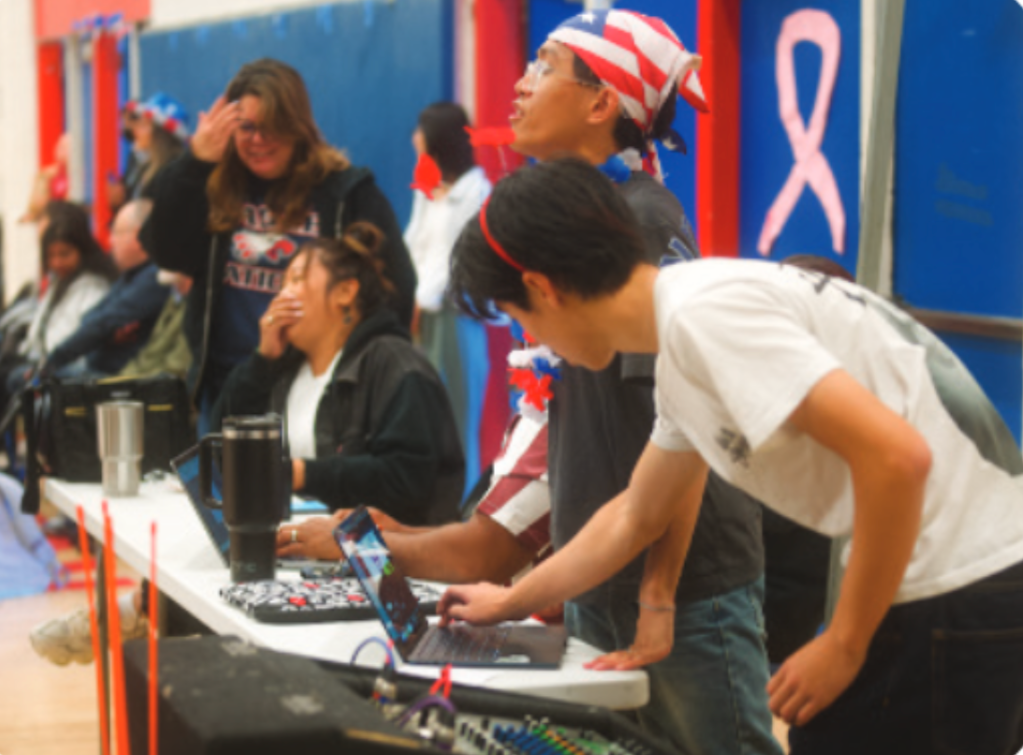
After weeks of preparation, Wilson Lo (12) and Francis Garcia (12) worked out the last-minute technical issues before the rally began (Photo Credit: Jonathan Wang (12)).
Participation isn’t the only challenge; once the rally begins, hundreds of students are packed into the gym, and everything has to work seamlessly. During this year’s rally, audio presented its own challenges. Wilson Lo (12), an ASB member responsible for audio, said, “WiFi is unreliable, and I loaded the audio off WiFi, so it cut out a little.” When asked about solutions, Lo explained, “The easy solution is to download audios, which we are going to do from now on, especially the [scripted] audios.”
Each class also faced their own struggles with preparation for Spirit Week’s most anticipated part of Spirit Week: the dances. Choreographers faced multiple challenges, from making dances accessible to all to securing the right materials.
Fortunately, support from the community helped fill in the gaps. “One dancer’s mom donated more bamboo sticks [for the tinikling dance] on the day of our rally. That’s why there were more during the performance, so it worked out in the end,” Garcia added.
Choreography itself required constant collaboration to make sure dances were easy to follow. Step choreographer Devyn Ford (12) explained, “It took a minute to really understand how to make something that’s easy for everyone to learn and also fun. I asked for a lot of help. People gave suggestions, and we worked together to make it better.”
The work extended beyond the dances in the rally as well. Set design demanded planning, coordination, and most of all, time.
“This year, [the elects] planned an official all-nighter to work on the set, and it was amazing. A lot of people showed up, even faces I never expected,” said Jain.
Even with that commitment, preparing for set design brought its challenges. “Setup day [of the set design] was chaos. We needed a U-Haul to move the car [made for the set], but everything got delayed. All the other classes were already setting up while we were still waiting to get ours to campus,” said Jain.
Despite the delays, the seniors pulled it together. “It was stressful—but we got it done,” said Jain.
From plastic pipes to first place
Despite minor hiccups, Spirit Week remains one of the most anticipated traditions. For all of its chaos and competition, it’s still one of the few times students come together to celebrate our school spirit.

Seniors cheered for their class during their final Spirit Week rally. “Seeing everyone come together for that last rally—that was honestly a moment of pride. Everyone just pulled through. We were all on the same side, fighting for the same thing, supporting each other,” said Paul (Photo Credit: Kai Sugano (12)).
For the Class of ‘26, though, that unity carried extra weight. When the news came in that the Class of ‘26 got first place, there was disbelief, then euphoria. “We really pulled it together in the end. We’ve always looked up to the seniors before us, and this was our chance to finally get to that level. And we did,” Paul said.
Looking back, Pawar said that the win felt like more than just a title. “What stood out most wasn’t just the dances. It was the energy, the people, and the feeling of doing this together for the last time. All of the time we put in was worth it in the end. Everyone came together and really put the spirit in Spirit Week,” she said.
 Eagle Era
Leave a comment