By Sachi Ladole
American Eagle has been a staple in the fashion world, but in its recent ad, it found itself in the spotlight for a different reason. The commercial featured Sydney Sweeney smiling and posing in jeans while a narration played in the background. The script included wordplay with “genes” and “jeans,” describing how traits like hair and eye color are inherited, followed by Sweeney saying “My jeans are blue.”
Some viewers saw the ad as simply promoting denim, but others argues it was much deeper, promoting eugenics—a pseudo-scientific movement in the 19th and 20th centuries that falsely claimed that traits associated with white Europeans were superior. Whether intentionally or not, the ad played into this ideology. Casmin Bui (11) explained, “It portrays white supremacy. She was the stereotypical white, attractive person. It comes off as ‘the white female is the best.’” During the Holocaust, eugenics influenced policies around immigration, reproduction, and racial hierarchy. In today’s political atmosphere, where exclusionary visions of America centering around whiteness are common, it garnered a negative response from people who are tired of seeing it. In this context, the seemingly innocent jeans ad became not only culturally tone-deaf but also politically charged. American Eagle’s decision to run this ad, despite the troubling implications, drew criticism for prioritizing publicity over ethical practices.
In response to this backlash, American Eagle responded on their Instagram, saying that their “‘Sydney Sweeney Has Great Jeans’ is and always was about the jeans,” and that they’ll “continue to celebrate how everyone wears their AE jeans with confidence, their way.” Still, the ad was tied to that troubling history. According to Forbes, in the same weeks that the ad dropped, there was an almost 9% drop in foot traffic at American Eagle stores.
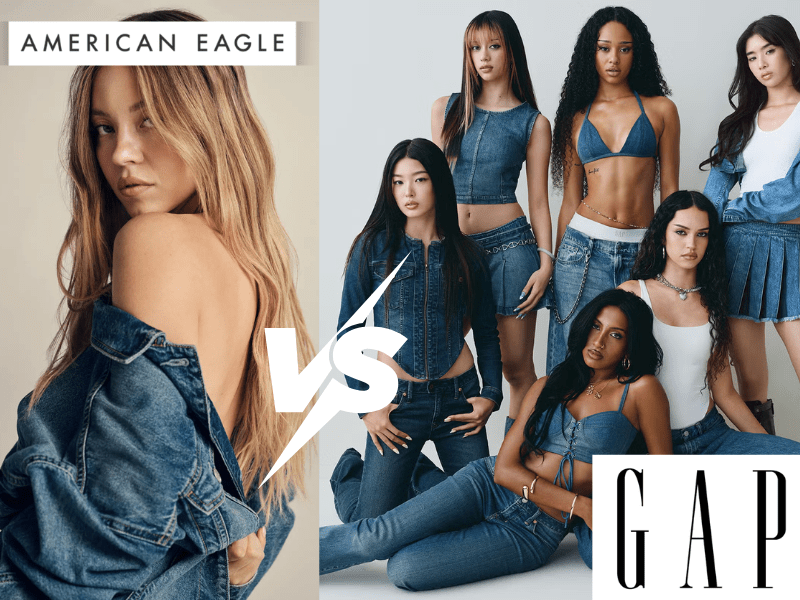
The Gap and American Eagle ad campaigns were both created to advertise their denim, but the public reactions were very different due to the difference in execution (Photo Credit: American Eagle and Bjorn Iooss) (Art Credit: Sachi Ladole (9)).
The lack of energy also doubled down on the ad’s issues and took away from what was required to make it a hit. “Sydney Sweeney was just sitting there on a chair saying, ‘My jeans are awesome.’ There wasn’t anything to it,” said Fatima Mansoor (11).
Soon after, Gap entered the conversation with its own denim campaign surrounding a celebrity—the same basic concept as American Eagle, yet entirely different. Their denim ad featured rising international girl group Katseye, who performed original choreography by Robbie Blue to Kelis’ 2003 hit “Milkshake.” This video leaned less on narration and more on music, movement, and group performance. Unlike the Sweeney ad, Gap’s campaign exploded online not because of controversy but because of sheer popularity and a generally positive public opinion. The ad has already racked up 31 million views on Gap’s official YouTube alone, not accounting for countless fan remixes and dances on other platforms.
Like many others, Rithika Hari (9) felt the difference between the two ads immediately. She said, “I really liked the dancing and the choreography.” She also noted how Gap was able to highlight their products more effectively. “With the Gap ad, they showed a variety of their jeans—they had baggy ones and flared ones.”
It’s safe to say that Gap’s choice to lean on dance and music in the age of viral audio clips and TikTok dances felt more in touch with the youth of today in contrast to Sweeney’s ad. “The Katseye ad really landed perfectly. I think it was perfect for our generation,” said Mansoor.
For Bui, the Katseye campaign also signaled something even larger. Bui said, “I feel like the Gap ad represents progress in our society. It is leaning toward representing more diversity, and more races are being portrayed as the years go by, which is what America should be.”




 Eagle Era
Leave a comment