
With the upcoming special elections in California taking place on November 4th, many seniors at AHS will have their first opportunity to vote on propositions. 12th-grade students are also required to take their first government class, where they learn the structure of the American government, institutions, and political processes. But with the current volatility of the political landscape, both in the U.S. and in the world, many wonder if the seniors at AHS are prepared to navigate the complexities of politics and if they are mature enough to make decisions as important as voting on policies.
Edward Jin (12) believes that he and his peers are ready to begin voting. He said, “We have abundant resources to educate ourselves about the intricacies of government.”
However, Thomas Lin (12) has a more cautious stance. He said, “I personally know that I am not well informed about politics. Many of my peers seem to be very passionate and very strong in their own political opinions, and so I believe some of them are well informed. But I’m not sure if most of them are or are not.”
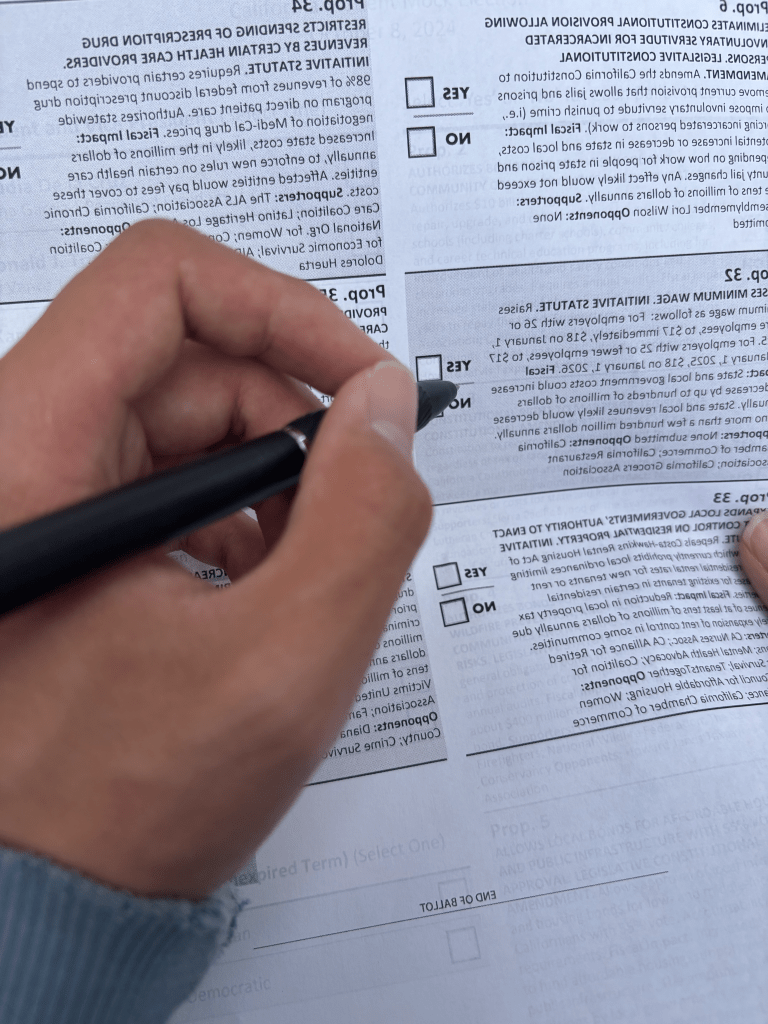
Thomas Lin (12) looks over the 2024 election ballot. He said, “The political issue I’m most concerned about is any world wars that could break out. There has been conflict between Ukraine and Russia since I was in middle school, and currently there has been conflict with Israel and Palestine and heightened tensions with China” (Photo Credit: Jonathan Wang (12)).
AP Government teacher Mr. Noori believes his students are mature enough to begin voting and makes it a point in his class to keep his students informed about politics. He said, “I think it’s very important to make the news a part of the curriculum even though it’s not really tested on the exam.”
Students in his class are assigned a current event news topic, and they must research and present it to the class. “Initially, I was talking about it myself, but I thought it would be a better idea if they discovered the news rather than me just telling them the news,” he said.
Drawing on his years of teaching experience, he explained how some issues attract different levels of student curiosity. “Civil rights really interest students; they engage in discussions on provocative topics such as guns, capital punishment, and free speech.”
The current times also have a clear impact on the way students are processing not just politics and news, but information in general. With social media, students can immediately access news and often graphic content on their phones. Rishab Sehgal (12) said, “It makes it much more real. Seeing it is a whole different experience. It makes the issue much more transparent.”
Mr. Noori said, “I noticed during Trump’s two presidencies, students have been more aware of politics. I felt like during the Biden years, there was a bit of disconnect from the students—they went back to not paying attention.”
“The current political landscape in the U.S. is super partisan, and it’s very radical. I think that with the two-party system, it’s pretty much impossible for any middle ground to occur. Each election cycle, the two different parties spend half their time undoing what the other party did the previous term. It makes it all the more important to participate in local elections and build your community how you want it,” said Jin.

 Eagle Era
Leave a comment