Testing experiences with the shift to digital exams and its changes to students’ preparation strategies
May 2025 is the near end of paper-and-pen College Board AP exams, and the start of hybrid and digital exams. Out of the 40 AP courses and exams that College Board offers, 28 AP exams will discontinue using the standard paper testing format. These exams will now take place through a digital testing application, called Bluebook by College Board. According to College Board’s website, paper exams “in these subjects will only be available to students approved.”
Out of the 28 digital exams this year, 16 are in a fully digital format while the remaining rest 12 are in a hybrid digital format. The fully digital subjects include history, government, and English courses. These will consist of students completing the multiple-choice and free-response questions in the Bluebook application. The hybrid digital subjects include math, science, and economics courses as their exams “require graphing or symbolic notation,” according to College Board. In these exams, students will complete their multiple-choice questions on Bluebook. They will also view their free-response questions on Bluebook; however, the answers to these questions will be handwritten on paper exam booklets that will be scored later on.
The hybrid digital subjects include math, science, and economics courses as their exams “require graphing or symbolic notation,” according to College Board. In these exams, students will complete their multiple choice questions on Bluebook. They will also view their free-response questions on Bluebook; however, the answers to these questions will be handwritten on paper exam booklets that will be scored later on.
Students have made adjustments to their study techniques due to the new digital format. Senior Elisa Varghese said, “I have done more digital practice because a lot of the practices are online which has made it more convenient to access and study, so you don’t have to bring a textbook everywhere you go.” Diya Kulkari (11) who is taking AP Biology, a hybrid exam, and AP Language and Composition and AP Psychology, both fully digital exams, prefers digital exams. She said, “I learned that they were going to switch to digital and hybrid format in 10th grade, which is when I was fully sure about taking AP Lang. I was really happy since I didn’t want to hand write three essays in two hours and fifteen minutes since my hands get sore really quickly.”
On the other hand, Tanvi Bhide (12) who took AP Macroeconomics and AP Calculus AB, which were both hybrid exams, and AP U.S. Government, which was fully digital, prefers paper exams. She said, “I prefer paper exams because they’re much more straightforward and I am most familiar with that formatting. Paper also helps me think a lot better because I can write out my responses. The hand-mind coordination when writing is much better than typing.”
As the AP testing landscape continues to evolve, students, AP exam proctors, and possibly teachers have to learn and adapt to new formats that include technology. While technology may provide convenience and efficiency in terms of planning and scoring, there may also be some difficulties in terms of its technical reliability. The future of AP exams, however, still appear to become increasingly digital, bringing both opportunities and challenges for students and educators alike.
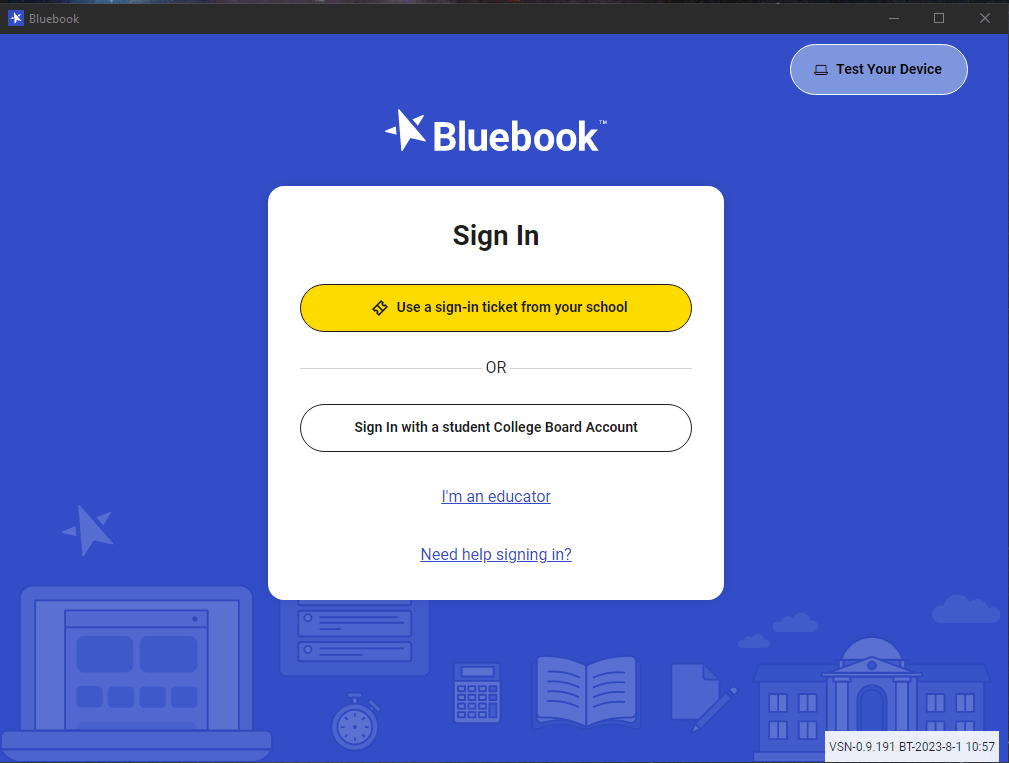
This image displays the sign-in page for College Board’s Digital Testing App named Bluebook. (Photo Credit: John Jenkins from Prince William County Schools)



 Eagle Era
Leave a comment