AP Art history wraps up their modern art unit, but what value does such art hold?
Staff Writer
AP Art History has finally concluded. Having finished memo- rizing 250 artworks, their artist, medium, date, culture, and story; art history students have all but given up on thinking about art. Despite this, one conversation topic remains: was the contemporary art unit even that good?
While contemporary art, or modern art, is any piece of art- work from the late 1900s to early 2000s, its name comes with many connotations. “To me, art requires putting in hours of work,” Tiffany Yu (11), an AP art history student, said.
This often conflicts with stereotypical modern art works. Comedian by Maurizio Cattelan is a collection of bananas duct-taped onto a wall. Despite this, it sold for up to $6.2 million.
Some, like The Guardian, con- sider it to be a brilliant satirization of the state of modern art, claim- ing that its low effort mocks the lack of effort of other modern art- works, while the use of a banana displays the reach of globalization.
Others have mocked it. “I guess it’s creative, but even I could do it,” Yu said. The AP Art history teacher, Mrs. Olson had conflicting thoughts. “I like contemporary art because I like having to think. The artists are push- ing boundaries and looking back at all of the things that came before,” she said.
Ultimately most artists agree that art requires a human touch.
“I think art is a wonderful way to sort of communicate who you are as a person, to leave an imprint of your soul on the world, and to try to distill what happens in your life and trans- mute it into something that other people can understand visually,” Mrs. Olson commented.
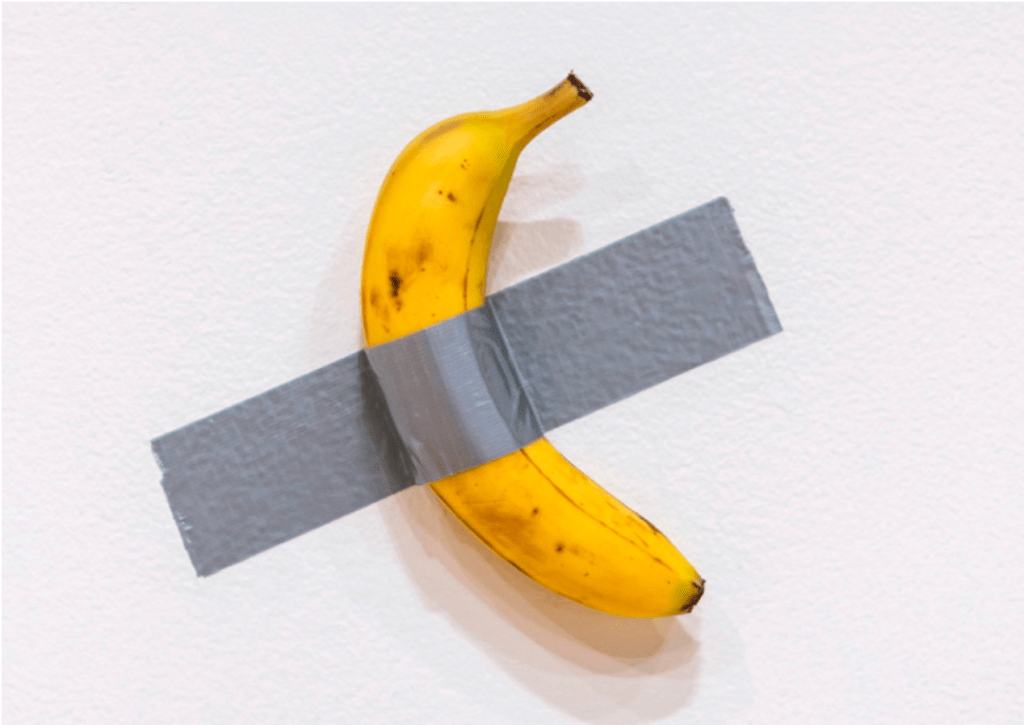
Contemporary art, such as Come- dian by Maurizio Cattelan, has sparked conversation about the phenomenon that is contemporary art. Photo Credit: CNN).



 Eagle Era
Leave a comment