
In a world that didn’t always listen, Gautam Sharma found his voice in animals and the quiet resilience they embodied
Staff Writer
Some kids grow up learning their ABCs. Some kids grow up playing in the jungle gym. But for Gautam Sharma (11), childhood meant explaining why his hands moved differently, why his words sometimes got stuck, and why people didn’t always treat him like everyone else. Yet, those early lessons taught him something bigger—empathy, maturity, and a deep connection to the quiet world of animals.
Before he could find connection in animals and the world, he and his family had to navigate years of uncertainty, tracing back to his earliest years when subtle signs first emerged. His parents noticed discrepancies like difficulty speaking and trouble eating solid foods and decided to seek medical advice. But, doctor after doctor, they all said the same thing: there is nothing wrong. “We had to kind of struggle through the medical system,” said Gautam’s father, Ratnesh Sharma. “They kept telling us he’s going to grow out of it.”
Regardless, the conditions persisted and exacerbated. It wasn’t until they consulted more than 4 doctors that the cause of his condition was discovered, a diagnosis that rocked their world. At a young age, Sharma was diagnosed with Bilateral Perisylvian Syndrome, a rare neurological disorder that affects the cerebral cortex, along with an assortment of other related conditions. Caused by an insufficient separation from his twin, who tragically passed away in the womb, this led to oral and physical motor control issues which have continued to affect him to this day.
Yet amid that uncertainty, something else was quietly taking root.
Despite his struggles, Sharma was falling in love—not with people, but with animals. His fascination began in elementary school, sparked by watching documentaries that pulled him into a rabbit hole of curiosity. “There’s a lizard that’s able to walk on water, and there are bats that are able to echolocate,” he explained with enthusiasm. Whether on wilderness trips or getaways in his wooded vacation home, Sharma found refuge in animals, realizing they, like him, communicate in ways beyond words. “Animals don’t talk, right? They can’t express themselves, so you have to understand from their physical demeanor what they’re looking for. That’s what Gautam does—he’s learned to read the unspoken,” his father said.
By the time he reached middle school, the contrast between him and his peers became clear. “People weren’t necessarily mean, but I could tell I wasn’t being included in the same way. I think that’s when I really understood I was different,” said Sharma. Children had preconceived notions of who he was and what he was like. People would assume he was in special education classes, though he wasn’t. Sharma described experiences with teachers sometimes infantilizing him, treating him like a child by speaking to him in an overly sweet tone and oversimplifying concepts he had already mastered. This treatment was rooted in ableism, where his differences led others to underestimate his abilities.
It was through these experiences that Sharma was pushed to develop a level of maturity and emotional intelligence far beyond his years.
“He’s not the type to give a big speech if you’re hurting,” said Jackson Drainville (11), a close friend of Gautam. “But you’ll feel it. Like when my fish died, I got emotional. I remember [Gautam] put his hand over my shoulder and talked about some [similar] experiences he had. And he just indirectly comforted me. He told me, ‘It happens. You’ll just have to move on.’ He’s not super direct at times, but you can tell when he’s going to help you.”
In the same way he comforted others, Sharma’s connection to animals deepened. Seeing the mistreatment of animals by humans, Sharma made it a mission to help animals. In the summer of his sophomore year, Sharma shadowed a veterinarian, where he learned how to assist and conduct basic operations on animals. He has since embarked on a literary journey, spending his free time writing a murder mystery book from the perspective of a police dog. His passion for animals and his ability to connect with them have only grown stronger along the way.
“He’s just a normal guy,” Drainville said. “Yeah, he talks a bit differently, but don’t judge him by that. Talk to him. You might end up binge-watching Doctor Who with him. And trust me, he’d love that.”
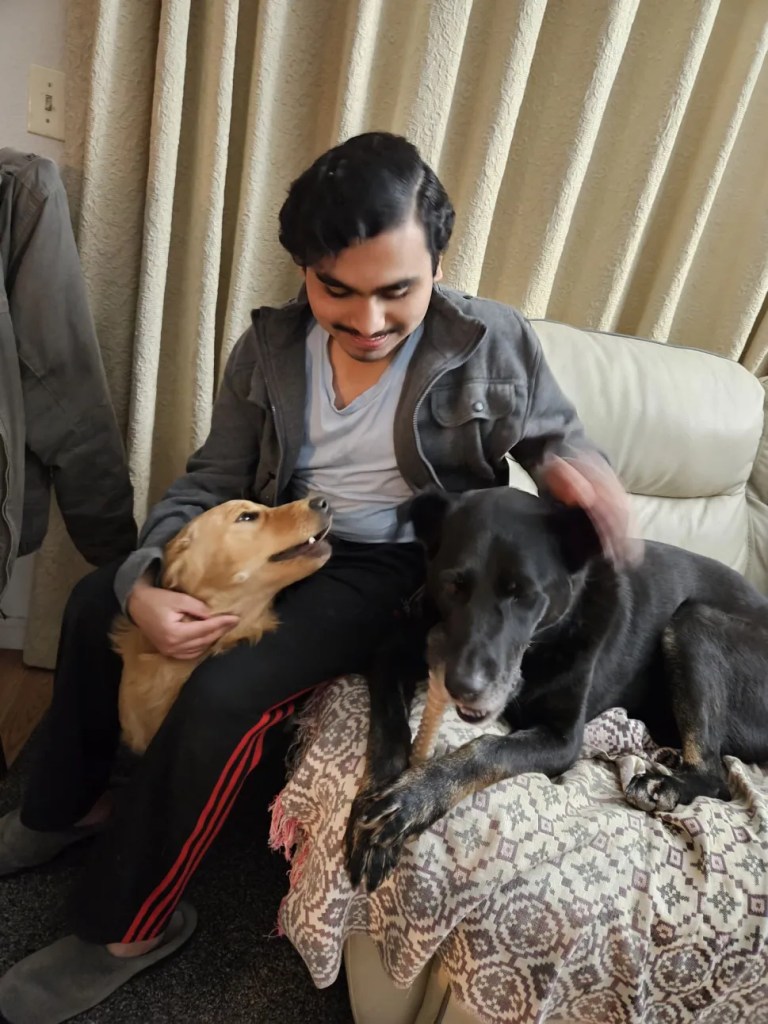
Having gotten two dogs, Aurora and Nova, not long ago, Gautam has found immense joy with them. “They’ll have a lot of hair coming out, their paws are dirty, yet no matter what, Gautam provides good love and care to them,” said his father (Photo Credit: Ratnesh Sharma).



 Eagle Era
Leave a comment