Pay $100, suffer for months, and forget everything by July
Staff Writer
AP testing is starting in a month, and while April could be wisely spent praying that AP teachers don’t assign a project at the end of the year instead of giving free periods, the AP routine dictates that the following weeks be spent with a frantic mix of studying, complaining, and questioning life choices.
The impact of AP testing on students begins well before the tests actually begin—when many students enter a state of denial. It starts with blissful ignorance, a time when students assume that their study routine of reading through their textbook for ten minutes a day every week is sufficient to cover the entire year’s worth of material. Unfortunately, unbeknownst to most students, skimming through the textbook while scrolling Instagram on the side isn’t the best study method. A month seems like a long opportunity to study. Yet, when the first few practice exams start being assigned, what seems like an easy review turns into a brutal wake-up call. Still, morale stays strong for the most part because of the common sentiment that “the grading scale will be generous, and I only need a 3 on the exam.”
A week before the test begins, this denial turns into rage. Copi Yum (10) said, “I’m actually about to crash out. You’re telling me I spent over a hundred dollars on taking this test, and I still only have a chance to get my score counted for college credit? I tried venting to my friend about how stressed I was feeling, and he just laughed at me and told me to read my psychology textbook for a solution! If one more person tells me how they haven’t started studying for their seven consecutive AP tests yet, and how they’re confident they are getting a 5 on each one, I’m gonna lose it.”
On the day of the test, reality hits like a semi truck, with students trying to negotiate their way out of earning a 1 or 2. While some might try to recall obscure facts, hoping a vaguely familiar term could be used to answer a question, others might resort to throwing everything they can at a question in the hopes it might score partial credit. Then there’s the ultimate act of desperation—trying to justify a completely incorrect answer.
“I just started drawing historical figures at the end of my second free-response question last year,” said Ami Cookd (12). “It was the AP Physics 1 test, so I don’t think it would be exactly appropriate for that situation. Although, it was a pretty fire image of Abraham Lincoln skateboarding down a thirty-degree incline.”
After testing, students enter a depressed state, trying to process how well they might have scored. Students compare answers, only to realize that none of their responses match.
“I just sat in my car for thirty minutes after my AP Biology test,” said Nomor Hope (12). “I just sat there processing. I think I’ll just spend the entirety of the AP Physics 1 test playing tetris on my TI-84.”
As students begin to accept their performance on the test, it begins to fade from the mind completely—until July, where scores are released. For some, checking scores is a moment of triumph.
“I was so nervous when I checked my College Board account, and when I saw a 1 on my AP World History score, I almost fainted,“ Delu Shin (10) ecstatically exclaimed. “I can’t believe I got first place. Of course, I already knew I would ace that test.” For others, it’s a painful confirmation of what they already knew.
“I opened the email, looked at it for 5 seconds, and then went back to sleep,” said Cookd.
Regardless of the outcome, the cycle continues. Many students, despite swearing they would never put themselves through this stress again, keep finding themselves signing up for more AP tests the following year.

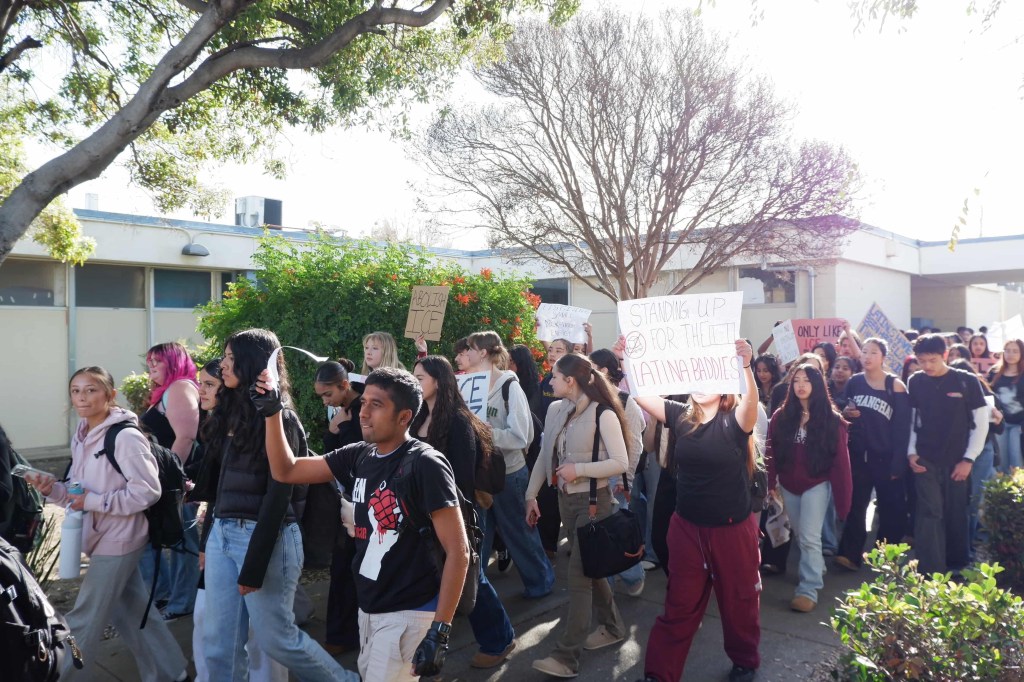
Students only realize how unprepared they are for the AP test after they start seeing the questions (Photo Credit: Lance Wang (12)).



 Eagle Era
Leave a comment