The lunchtime basketball tournament was reworked to improve player experience
Staff Writer
AHS’s rendition of March Madness was a three-week, single-elimination basketball tournament named and modeled after the prominent NCAA event with the same name.
The tournament was three weeks long, and games were hosted during lunch in the gym. The 16 teams were made up of AHS students who signed up together, and each team had five players.
The first week consisted of 2 games per each day from March 4th through the 7th. The next week, March Madness was on pause due to International Week. The second round took place with 1 game per lunch during the week of the 18th through the 21st. The last week included semifinal games on the 24th and the 25th, then the final game on the 28th. In the final game on March 28, the Aaravengers won 14-13 against Yunggunnawanna.
AHS Leadership’s Athletics Committee hosted the event and played a significant role in organizing the teams. Akarsh Ranjan (12) participated in March Madness last year, and as a member of the Athletics Committee, he called upon his prior experiences to implement several changes to improve the tournament. “This year, I’ve made it a statement to come here to come here and change everything that made it not so good last year.”
One major change was limiting the number of teams that could sign up. “I feel like last year, it got too hectic,” said Ranjan. “So I put a cap on 16 teams, just like how March Madness does it. It’s so much easier.”
“Another complaint last year was that there’s too many games,” said Ranjan. “Normally, there are 2 games going on at once on the side courts, and those courts are smaller. They’re not that good in comparison to the full court.” This explains why March Madness shifted to having only 1 game per day starting in the second week, allowing for the use of a full-size court.
Yet another new addition to March Madness this year was that teams could select coaches. Raghav Sharma (11), a coach for the team Cokebuttacheese, described how he saw his role in the team. “I was there to make sure my team knew exactly what to do. Just being there, monitoring them, and making sure they know what to do, especially in tight games like March Madness where we have less time and we need more points.”
Ranjan described the inspiration for adding coaches. He said, “Why not try to create the same atmosphere as a high school basketball game, or maybe an NBA game where there is a coach on the sideline?”
Overall, March Madness was a popular event on campus, an opportunity for students to come together to play and watch basketball. Emily Su (12), a Leadership student and Class of 2025 Senator who assisted with crowd control, observed the appeal of the event. Su said, “It’s a nice way to bring friends together, especially since a lot of people are involved in basketball.”
Sharma agreed that the event fostered a sense of community. He said, “It’s great that people are coming together to watch sports, especially during lunch. Just being there with everyone and supporting your team is a lot of fun.”
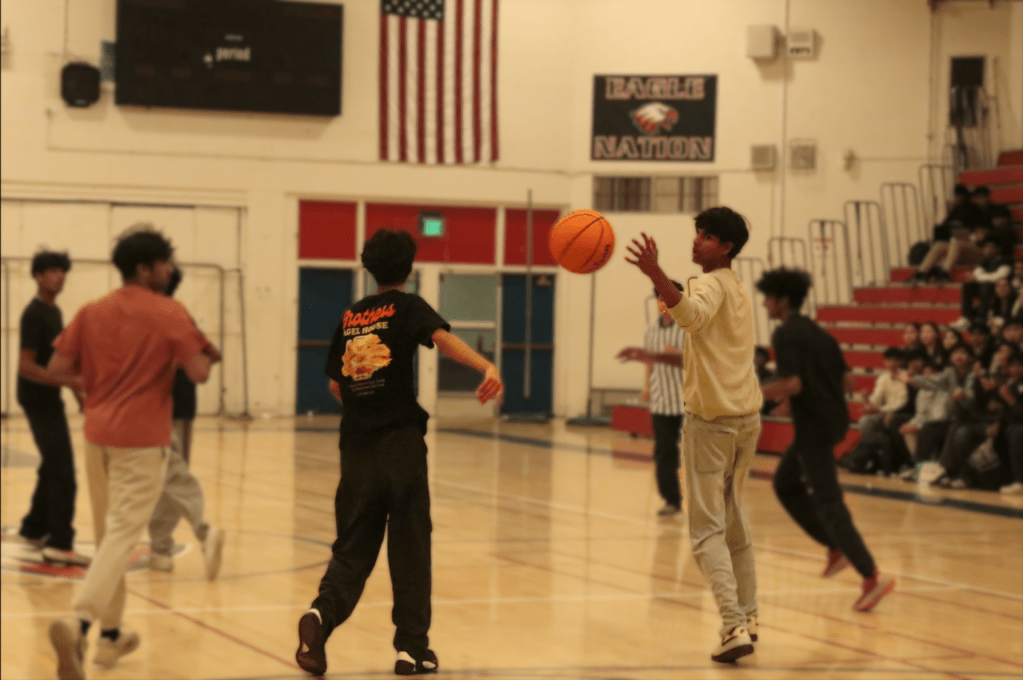
Audiences watch the second semifinal game on March 26th, in which Yunggunnawunna won 8-7 against Cokebuttacheese (Photo Credit: Aruna Harpalani (11)).


 Eagle Era
Leave a comment