Lin-Manuel Miranda, come home, the kids miss you
Staff Writer
Moana 2 seas-ed the box office Thanksgiving weekend, grossing nearly $398 million globally, opening weekend. It follows the titular character, Moana, as she balances wayfinding and her obligations to her people. Like the original, the animation, musical numbers, cultural elements, and characters invite audiences to become entirely immersed in the world. Unlike the original, which was universally praised by critics, Moana 2 has been criticized, largely due to its soundtrack.
Moana’s score was written by Lin-Manuel Miranda, leading composer of Hamilton, Encanto, and In the Heights. Miranda is revered for the infectiousness of his soundtracks, with “How Far I’ll Go” and “We Don’t Talk about Bruno,” remaining relevant in pop culture months and years after their theatrical releases. However, Miranda did not return for the sequel, and Disney instead opted for songwriting duo Barlow and Bear.
Abigail Barlow and Emily Bear are the first and youngest team of female composers on a Disney-animated film, renowned for their Grammy-award-winning The Unofficial Bridgerton Musical.
Among critics, their score pales when compared to that of Moana’s. Chicago Reader critic Andrea Thompson, wrote, “What’s not to love? An absence of Lin-Manuel Miranda, for one, who—in spite of protests regarding his omnipresence—is still so good at his job that he can only be missed.”
Student Pranathi Kande (10), said, “I wouldn’t say it’s bad. It was just a little boring. It sounds too much like everything I’ve already heard before.”
Barlow and Bear are pop-songwriters, with their greatest strengths lying in an entirely different writing process and style. Their The Unofficial Bridgerton Musical went viral, capturing audiences as they teased each new song on TikTok, and Bear has since performed with the likes of Beyonce and written scores for Netflix.
Instead of writing what they excelled at, they attempted to recreate the magic of Miranda’s score, releasing “Beyond” and “Can I get a Cheehoo?” which are sonically and thematically identical to “How Far I’ll Go” and “You’re Welcome.” Songs like “We’re Back” and “Get Lost” were the highlights of the soundtrack, memorable standalones that didn’t seem to rehash the first movie’s bests.
The cultural elements of the soundtrack remained spectacular. Returning composers Mark Mancina and Opetaia Foa’i worked on the Polynesian instrumentals and backing vocals that accompanied each song, establishing the heart of the film: its cultural world-building.
Accusations of a weaker score, however, were inevitable as the composers were subject to criticism even before the movie’s release. Audiences are fickle, clinging to the familiarity of a sequel yet despising when it strays too far from the source. Had the composers stuck to their forte in pop, audiences likely would have reacted equally viciously for betraying Miranda’s score, and in trying to mimic what made the first great, they ultimately produced songs viewers found underwhelming.
In an interview with Variety, Bear said, “Writing a sequel is really difficult because you’re never going to be able to recreate the feeling of the first one. People like what they know, and this is new.”
Moana 2 was decent, and still worth seeing in theatres. The new characters and relationships are captivating, and the animation distracts from some of the score’s and storyline’s weaknesses. It’s good as it stands alone, and the nostalgia of old characters and the representation of new ones are its greatest strengths.
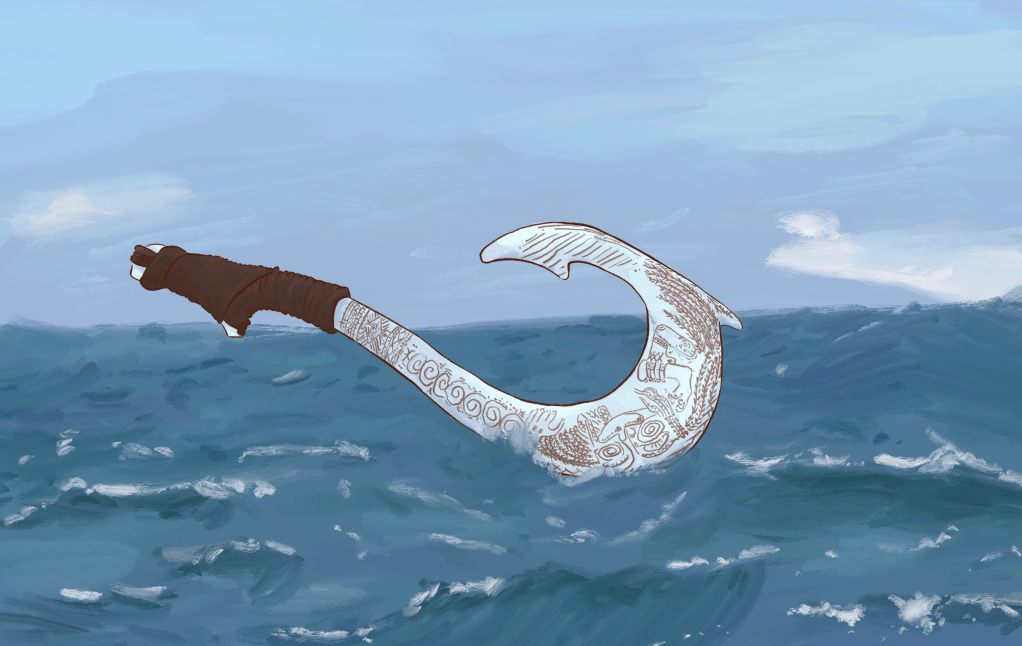
Maui’s iconic hook lost at sea (Art Credit: Ivan Chu (11)).
 Eagle Era
Leave a comment