Emmy Award winner and Nobel laureate presents lecture on auction theory for the Economics Club
Staff Writer
Professor Paul Milgrom is a Nobel laureate, and recent Technical Emmy Award winner, for his work in auctionomics with the Federal Communications Commission (FCC). On Wednesday, December 4th, he presented a lecture at American where he discussed the basic concepts of auction theory.
There was a large turnout for this event hosted by the Economics Club, with around 60 students in attendance. “I saw a bunch of flyers around school and decided to sign up,” said Vinayakshara Ramisetty (12), “Economics has interested me, and Professor Milgrom is a Nobel Prize winner, so I thought I could learn something from him.” Professor Milgrom won his Nobel Prize for his work with the FCC in creating spectrum auctions, where the FCC used a reverse auction system to purchase radio bands from broadcasting services around the country.
“We’ve been planning this speaker event for a while,” said Bill Wang (12), Vice President of the Economics Club. “We sent emails to a bunch of professors, and we got extremely lucky that he was the one who decided to reply. He was open, and willing to even come to our school in person.” Professor Milgrom being award-winning wasn’t the only attracting factor; many attendees found the topics he discussed to be interesting.
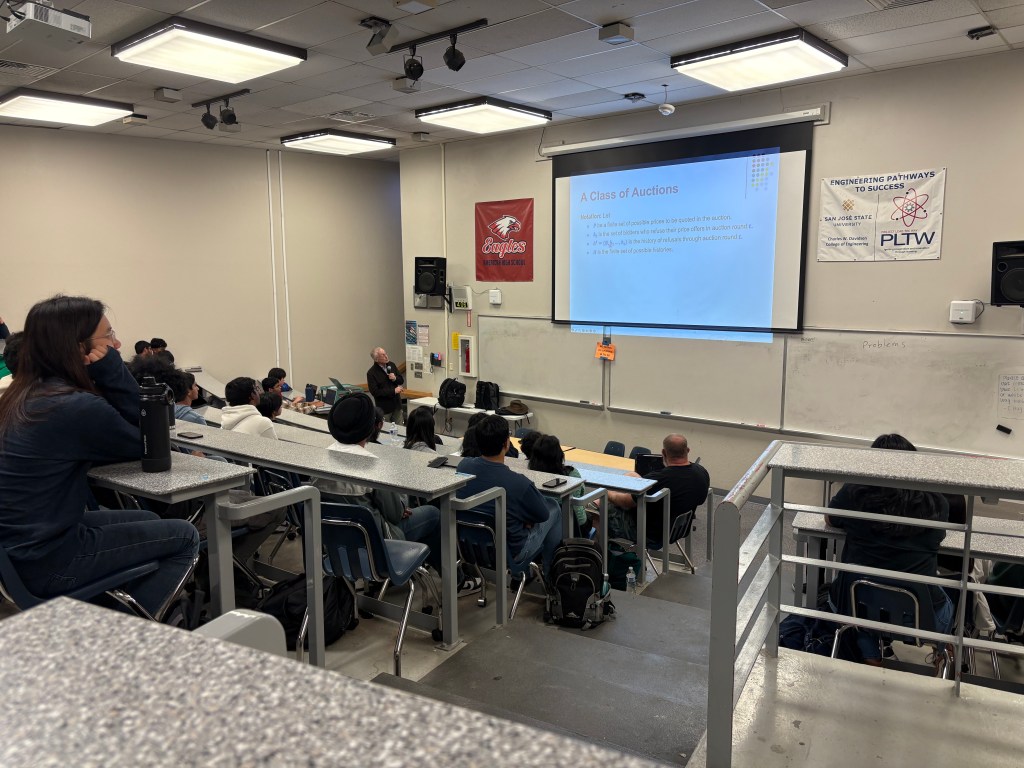
Professor Paul Milgrom explains the notation behind auctionomics. “One thing that he talked about that I thought was such a simple trick, was the descending clock theory—you can’t collude with your friends to increase the price. They purposely start off with a high price that everyone will want to buy into. But the price can only decrease. And I just thought it’s such a smart way to eliminate that possibility,” said Bill Wang (12) (Photo Credit: Aditya Padinjarel (12)).
“I liked how he talked about how his work led him to a Nobel Prize. The economy is literally a part of our life, and it is important to hear from someone experienced in the field,” said Ramisetty.
Professor Milgrom used the analogy of an overbooked airplane to explain descending clock auctions. An initial amount of compensation that every passenger would accept is given. From there, the amount of compensation is slowly decreased until the desired amount of seats in a certain section are given up. Then the process will repeat until all sections are filled and all oversold tickets are compensated.
Zikai Lian (12) was interested in “the fact that the FCC hired him to create an auction system for radio bands, and on a national level.” Similar to the plane example, spectrum frequencies, signals used by radio stations, were bought back from broadcasting companies by the FCC. They would offer an initial bid that all parties would accept, decreasing until there was only one buyer. This method prevents collusion, as multiple parties can not artificially increase the payout as it decreases.
“I think the biggest thing is it gives them life experience,” said former economics teacher Mr. McCluskey regarding the importance of such events, “When I graduated, it was like, go figure out how to do all these things, and I had no idea how. So [Milgrom] bringing his insight, even if it’s not the most applicable, [you] can learn that way.”
Students found the event with Professor Milgrom to be informative, especially for people who may even consider pursuing a career in economics. As Wang said, “It’s just an important skill to know in general, important for you to get a grasp on the world around you. And I think it’s really interesting.”

Group photo of all the event attendees alongside Professor Paul Milgrom. “I thought it was wonderful. Really lucky that we got the speaker because he didn’t just teach economics. He taught this really niche concept. Auctions, you don’t really learn about that. I think it’s wonderful,” said Bill Wang (12) (Photo Credit: Yonglin Cai (11)).


 Eagle Era
Leave a comment