
How clubs attract students through their unique visuals
Staff Writer
Every year during Club Rush, students gather in the rotunda of American High School and meet an array of posters, decorated tables, and creative displays—all designed to bring attention to different clubs. While Club Rush serves as an opportunity to recruit members, it’s also a showcase of how clubs use visual creativity to spread their missions and identities.
For many clubs, their ability to attract people relies heavily on their use of visuals—creative displays with clever illustrations, striking colors, and engaging interactive elements. Food Science club’s creative director, Erin Tahk (11), said, “We thought of using gray and blue because it reminds us of science, and it matches with our mascot, a gray rat named Franklin.” Tahk also shared another unique approach to help the club be noticed, “We had people take pictures with Franklin, which helped attract people.” This club successfully balanced creativity and engagement by harnessing an eye-catching color palette and mascot together to attract curious students.
This strategy proved to be effective, as demonstrated by Maya Oleynik (11). She remarked, “I joined the Food Science Club because when I read their poster, I noticed they have events making ice cream; it’s free food, I liked it.”
Similarly, Youth Alive, a Christian faith-based club, created a visual experience that connected students and reinforced their mission to explore Christianity and create a sense of community. President Jeremiah Tan (12) explained how they used meaningful symbols that represented the club to invite people in. “We used a wooden cross passed down from previous years and added vines to represent life.” In addition to the cross, the club used large, attention-grabbing letters on their posters to stand out.
Worship leader in Youth Alive, Benita Arun (11), emphasized another key element of their approach: music. “We thought it was a great way to spread the gospel because everyone will be there and can hear the song and be blessed.” She noted how the music made their message more digestible and impactful. Arun also added, “People love music; it’s more than just saying words or speaking a message. It will draw people in.” This combination of visual and auditory worked together to help create a welcoming display that appealed to students exploring and expanding their faith.
In Fashion Club, publicist Faye Cheung (10) stated how she and another publicist of the club collaborated to create creative custom elements to show the club’s passion for fashion. Cheung expressed, “We don’t use templates. We make everything from scratch,” highlighting the officers’ commitment to putting effort into every detail.
Compared to the other clubs, the Asian and Pacific Islander Club used media to attract students. Grace Wagas (11), a publicist in the club, explained, “We made reels; we made them fun so we can seem more relatable.” This helped show the club’s friendly atmosphere, encouraging potential members to join.
Every club brought its own creative touch to Club Rush, using visuals to relate with students and exhibit their purpose. Through various color palettes, symbols, and setups, clubs not only focused on recruiting members—they made sure to leave a long-lasting impression through their boundless creativity.
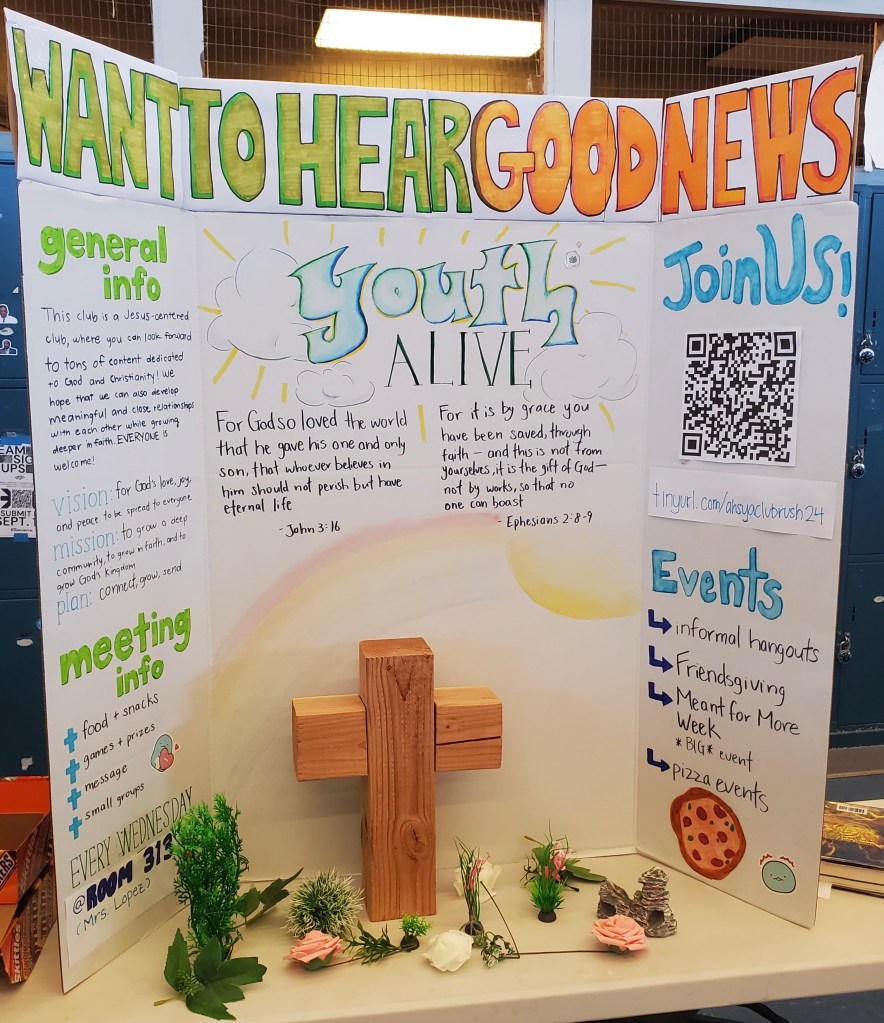
Youth Alive Club’s booth invites students with inspiring visuals (Photo Credit: Jeremiah Tan (12))


 Eagle Era
Leave a comment