
Jessica Li
Staff Writer
Ms. Mishal, Palestinian Social Studies teacher:
On Piers Morgan’s show, he was reporting on the rise of Islamophobia incidents and anti-Semitism around the world. It’s happening. It’s very unfortunate. It’s disgusting. And the caption was “Islamophobia versus anti-Semitism.” Why couldn’t it be both? Both are happening. It’s not one is more bad. I hate that it’s always depicted like it’s a competition, or which one has it worse.
For Israeli citizens, if they’re in the range where missiles from Hamas can hit them, they can evacuate, they can go to other countries, they can seek refuge elsewhere. But people in the Gaza are sitting ducks. They don’t have an official army. They don’t have their own currency. They don’t have the ability to import goods, export goods. You cannot refer to them as two equal bodies. They’re not in the slightest.
I don’t condone violence. I don’t condone what Hamas did on October 7 at all. I was heartbroken to see so many Jewish families destroyed by the hostage situation. But also we can’t forget the decades-long—almost centuries-long—conflict.
Many news sources assert that Israel has the right to defend itself. But there’s also conventions, there’s also international codes of conduct for war and to have ceasefire, humanitarian aid, to be brought in to give people an opportunity to seek refuge.
I grew up in New York City, and New York City has a really sizable Jewish population. So I’ve also been exposed to the Jewish experience and stories. In high school, we went to the Holocaust Museum, and we had a whole unit in English on the Holocaust. We read Night, we read The Book Thief, we watched Sophie’s Choice. I have nothing but empathy. But it’s very disheartening because everyone celebrates the creation of Israel. Finally the Jewish people who’ve suffered for many, many years have their own homeland. And everyone just likes to gloss over the fact that there were very much people living there as well.
We want to see this narrative that the Jews overcame all of this history of oppression to have their own homeland. But you cannot talk about it without talking about what happened to the Palestinians. And there’s a lot of efforts to erase Palestinian history and cultural identity.
My family’s from a very small village called Silwad in the West Bank. And where we live, there’s actually an Israeli settlement, which goes against international law. They’ve been building Israeli settlements in the West Bank, which was supposed to be a Palestinian state. And where my family lives, there’s right next to them a settlement called Ofra. And it’s built on the land that was confiscated from Silwad, which includes my inheritance, because my family lost their land. And those settlers will provoke the Silwadi people. The Israeli army will just go into the town and raid or stand at the entrance just to intimidate it. And they’ve been doing it more since the conflict began. So we’re very scared for our relatives who live in the West Bank, where they’re not under direct threat, like a war. However, even before this most recent conflict, it’s known that on Fridays, the Israeli army will come in and they’ll throw out tear gas. People just shut their windows, it’s a part of their routines.
Constantly, the narrative has been taken out of our control. We were never welcomed at the table, we never have a seat at the table to make any sort of impactful decisions. And then people say, “Why are they so mad? Why are they so upset? Why do they teach their children to hate?” And that’s not what’s happening. It’s really hard to live in peace when you’re not allowed to.
When I lived in New York, a lot of times my parents discouraged me and my siblings from attending rallies and demonstrations, because they were scared we would get labeled as anti-Semitic. Because especially in a place like New York, this is very ruinous for your reputation. You become essentially blacklisted. We know people who lost full-ride scholarships to Columbia University because they disagreed with a professor who accused them of anti-Semitism when they were like, “No, actually, this is what’s happening.” This is the nature of the conflict. There’s this side that’s not being taken into the equation. It’s really scary, because a lot of discussion gets shut down so quickly once the term anti-Semitism gets thrown around. And it’s not helpful. It’s not progressive.
For many students, it’s not often that they can ask someone who is Palestinian what’s going on there. So I appreciate them coming over to me and they’ve been approaching it very sensitively. And I’m grateful I can provide them some perspective. Also some of the Palestinian kids, we check in on each other because Palestine is many cities, many villages. We’re just making sure each family’s okay. It’s just good to see the camaraderie and the community come through in that way.
Unfortunately, I was surprised that no other teachers or admin have come and tried to talk to me about it. And I don’t know how aware everyone is of my identity. I’ve shared it, but I don’t want to assume people can just easily recall, ‘Oh, yeah, Ms. Mishal. She’s Palestinian,’ but I was a little bit taken aback that no one has been like, ‘Are you okay? Do you have family affected by this conflict? What’s going on?’
When I was a little girl, I would see things on the news and I was always, always hopeful that this war would be over at a certain point. Now I’m an adult, and I’m seeing there’s a bigger pattern here. It’s not going to resolve so nicely or so easily. And it just kills me every time.
As someone who teaches us history, I keep seeing how American and white settlers kept taking more and more native lands, and Native Americans would sometimes agree giving up some land because they’re like, “Okay, if we give them this, they’ll stop.” Now we have this whole United States. And I can’t help but wonder, is Israel taking a page out of America’s playbook? Is this what’s going to happen to Palestinians? Are we going to live in reservations where we’re trying our best to protect our culture and identity and preserve our language or dialect?
[Younger generation] approach things with a little bit more nuance. They understand that there’s a complexity there. So I’m grateful for that. And I just hope that they are trying to take in information from as many different sources as possible so that they can see where is the alignment because that’s probably true. Hopefully kids take it upon themselves.
Fern Tigri, Jewish student:
I’m seeing sources that are coming from inside of Gaza, listening to like Palestinian voices, trying to avoid major news sites because US is [backing Israel] and Israel is definitely the bigger one in that propaganda campaign right now. So seeing sources from inside of the area helps you actually understand it better, and you need to be careful because you never know who’s writing that source.
You’ll find a lot of Jewish people defending Israel’s existence, even when they don’t support what’s happening, because they’re worried that before even this current crisis has happened, anti-Jewish hate and anti-Semitism was already on the rise in the country.
If the histories of Jewish genocide keep happening, it can happen again. I think a lot of people are worried about it happening again. And the value of Israel to them is Israel will take any Jewish person—if you try to enter the country, you can become a citizen. It will act as a safe place for Jewish people if they have to become refugees, because otherwise they have nowhere to go. They can actually have a safety net, which I don’t think justifies the existence of Israel. But what I’ve heard from talking to Jewish people who support the existence of Israel is that they’re worried about: “What if something happens? Where can we go?”
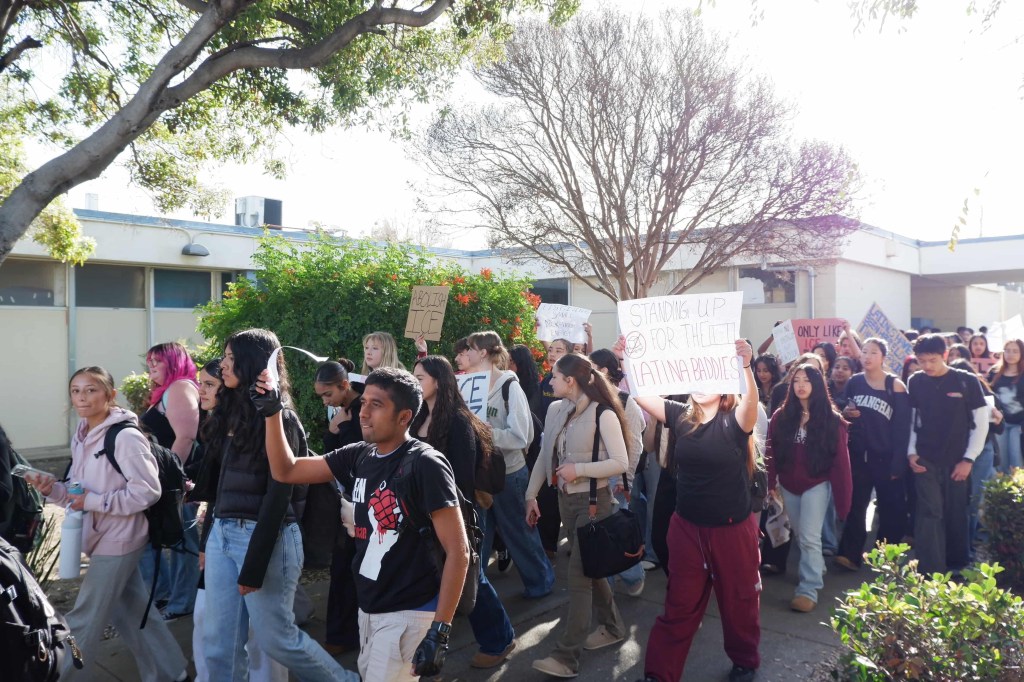
American High definitely has a more Palestinian population, which obviously is going to affect them. It would affect any of us if our ethnicity was being genocided in another country, that would affect all of us deeply. I know a lot of people here are participating in the boycotts to fight against Israel, and a lot of people are spreading news on social media, retweeting on Twitter, posting on Instagram. There are a lot of students who are spreading awareness.
People need to understand that issues are more complex than they give them credit for and yet they can still be incredibly simple in who is right. You don’t need to support Israel to understand the history of this issue. And understanding the history gives you more of an opinion on this that you can feel comfortable and secure in. Knowing the history makes you feel more like you want to bring attention to the governments who caused this issue, who brought Israel into creation and their motives behind it. Understanding why Israel exists is really important to understanding this issue. [The US government doesn’t] care about Israel. They don’t care about Palestine. They just want their oil and that understanding helps you to be able to fight better.
Raveeha Rabbani, Muslim Pakistani student:
It’s so one-sided. There’s a country who has one of the strongest militaries in the world and the other country doesn’t even have a military. The main talking point in Western media is self-defense. Self defense is not giving collective punishment to millions of people. More than 2 million people have been displaced, forced out of their homes that have to evacuate. The death toll has more than 10,000 civilian deaths so it doesn’t seem like self defense.
I’ve been to three or four protests here in the Bay Area. One of them was actually a discussion, a conference, and one of the speakers was talking about how he has never lived in Palestine…He was talking about how his whole family that was his extended family, who lived in Palestine and were killed a weekend before I went to the discussion. He seemed so confident and strong still. You can’t imagine if your whole family was killed, you wouldn’t be like that. You wouldn’t have the courage to come and talk about everything. He did. My whole life, I’ve never downplayed the issue and how started. Now it’s just become mainstream. It was always there, it’s been there since 1948.
One of [the protests] was in Fremont, in the library. People had posters and we had everything written on it and with all this people, you could see. You could hear the passion in their voices they wanted the genocide to end. They wanted ceasefire, that’s what they were advocating for. Even the cars as they were going by them would honk to show their support. And it was really nice to see that even here in America. There’s a community that supports the cause and not just here, there’s protests all over the country. There was one in Washington D.C. where more than 10,000 people [protesting] in front of the White House. I think that was really powerful.
In AHS, there’s a certain community of people who are really active fighters who are posting about it and who are talking about it. But the majority are unaffected, even some of the teachers. Teachers have a responsibility to educate students about what’s happening in general, not just here. So I think it’s been so overlooked. There might be someone who is Palestinian and their family’s suffering. It’s so scary to think.
There are a lot of Palestinians in the Bay Area community and I think they deserve to have their voices heard. People who are not educated about the subject need to be educated because it’s not really something where you can be neutral.
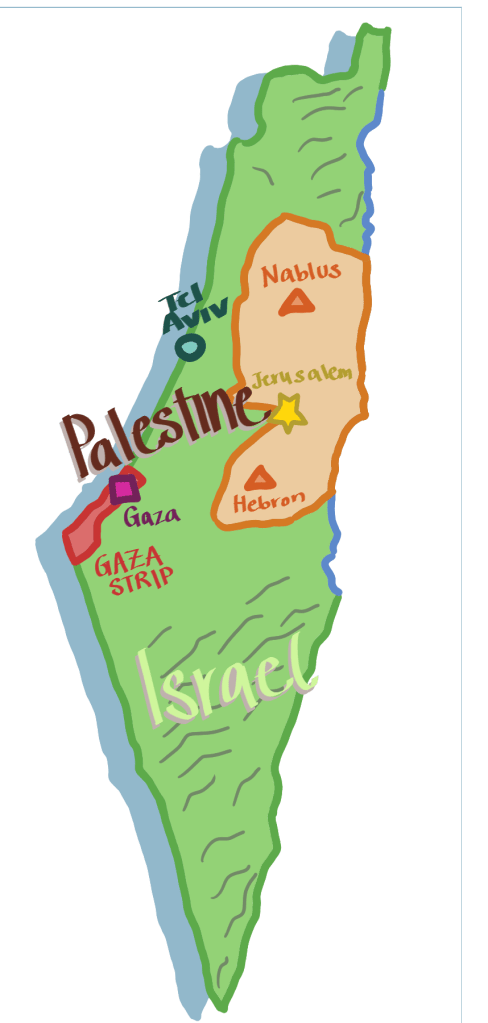
Caption: The infographic of the land between the Jordan River and the Mediterranean Sea shows the current labeled territories of Israel and Palestine. (Art credit: Jessica Li)

 Eagle Era
Leave a comment