Analyzing the collective focus on STEM classes at American and its role in students’ attitudes toward their career prospects
Staff Writer
With schools scrambling for more funds for their science, technology, engineering, and math (STEM) departments and more students at American signing up for STEM classes than teachers and space to accommodate, STEM has taken overwhelming precedence in the lives of students and the education system. But what does this overemphasis on such classes mean for students?
As the time to consider and plan for their career prospects approaches, students reflect on their motivations. “I think my pursuit of STEM is rooted in a stigma that you can’t pursue the arts or major in something that’s not STEM. Being in the Bay Area where it’s so competitive, and [American] offering so many hard classes has made me feel like pursuing a STEM career is the only option,” Anishka Jannu (11) said.
Contrastingly, some can attribute their academic pursuits to sincere passion. “My pursuit of STEM is purely based on passion, and I am fortunate to have passions that are related to that area of study,” said Jyoshika Balaraman (11).
However, the effect of American’s emphasis on STEM is not lost on her. “Unfortunately, I cannot say the same for everyone around me,” Balaraman went on. “My friend’s dream of being a writer was crushed by peer pressure to be an engineer. Another friend’s dream of being a graphic designer was lost when her parents pressured her to go into medicine. I see how much my friends are struggling as they are forced into certain careers based on whether they are seen as more respectable by society.”
Expectations within racial and ethnic communities to pursue highly paying, conventional jobs serve as motivating factors for STEM pursuit.“I have immigrant parents and if I pursued a career in the arts, which doesn’t necessarily guarantee a stable future, they would feel like I’m risking everything they immigrated here for. I think members of my South Asian community specifically would be skeptical and imposing if someone was going to pursue a career in arts, not only because of the salary but also because of how hard it is to become successful,” said Jannu.
Drawing from a similar sentiment, Balaraman said, “I do think I was often subtly pressured by my extended family to pursue a STEM career. In India, there is a stereotype that successful people are often doctors and engineers.”
While some may not feel pressure within their racial and ethnic communities or a sense of obligation that comes with holding an immigrant status or being a child of those who do, they recognize the ways in which pressure to follow a certain career path may serve as a loss for students. “My interest in STEM does come from a genuine interest but my parents weren’t so adamant on me pursuing it. I feel like a lot of students are only really interacting with STEM because their parents make them, even though some of them would do really good in an art career,” Jessamyn Glasscock (11) said. “When students view their jobs as more of an obligation than something they’re passionate about, it takes all the fun out of what they’re doing,” she continued.
Despite differing motivations, students collectively acknowledge various factors that foster a rigorous, pressurizing focus on STEM at American. “Even the school plays an influential role in a student’s career choice. The lack of pathways offered by the school for other popular careers shows the lack of balance in the school in terms of what kind of careers students plan to pursue. Teens then change their career choices to be able to utilize the school’s resources,” Balaraman said. According to American High’s website, the only clear pathways created by the school are the Engineering (PLTW) Pathway and the Computer Science Pathway. With no conventional pathways to explore other, non-STEM related areas of interest, students choose to conform to safer, more comfortable options.
When making decisions regarding career prospects, students may factor in negative social stigma regarding non-STEM subjects. “The biggest stereotype about STEM careers is that they provide a lot of money. There is also a perception that it is hard to find jobs with a non-stem degree. I definitely think both of those things aren’t true.” Balaraman said.
According to studies conducted by the National Science Foundation and the American Academy of Arts and Sciences, both STEM and humanities workers with a bachelor’s degree or higher experienced the same unemployment rate of 3.6% in 2021.
Still, students are not willing to take risks. “Although you can make a lot of money with an art career, I think it’s harder to be successful and the chances of making money through STEM careers are much higher,” Jannu said.
Ultimately, though the factors that a student prioritizes when choosing a career are subjective, American’s competitive atmosphere is one that impacts students collectively. Balaraman said, “If I attended another school, I wouldn’t be as academically motivated as I am right now. The pressure to be successful and the perceived instability of non-stem programs pushed me to look more into STEM careers.”
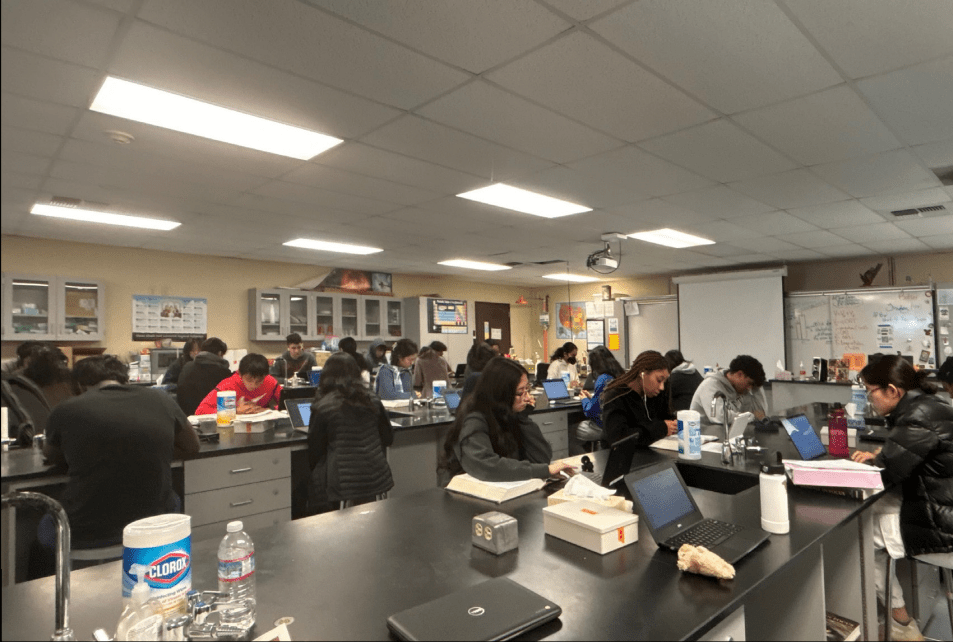
Caption: Students in one of American’s science classrooms. (PC: Vanessa Hinh (11))




 Eagle Era
Leave a comment